
HOA Insurance: 12 Risk Factors That Drive Your Premium

Last updated: May 26, 2026
Key Takeaway
The real cost of HOA insurance depends on twelve factors almost no online calculator asks you about — your community type (condo, PUD, mixed-use), your unit count, your building construction and age, your amenities, your claims history, and your governing documents' specific insurance requirements among them. Instead of a range that won't match what you actually pay, this page walks you through what moves the number and what to ask your agent so your quote reflects your actual association.
How much does HOA insurance cost in 2026?
There is no honest single-number answer. A 40-unit garden condo in Arizona pays completely differently than a 200-unit high-rise with pool and clubhouse in Colorado or a 12-unit brownstone conversion in Illinois — and all three pay differently than what an online calculator predicts. The twelve factors below are what actually drive your master policy premium. What your board will pay is determined by how those factors stack up for your specific community, which is why any quote worth trusting comes after a real conversation about your governing documents and property, not before.
FOR HOA BOARDS
The gap between the master policy and the CC&Rs is where renewals surprise boards.
The dec page shows the limit. The CC&Rs dictate what the limit needs to cover. When those don't match, the board has a governance problem before it has a claim — and the discovery usually happens at renewal, when premium adjusts to reflect what should have been there all along.
You searched for a number. We get it — board member trying to budget next year's dues, compare the renewal your insurance committee just received, or figure out whether the number your current agent gave the board is fair.
What you'll find everywhere else first: Zillow-adjacent sources cite wide per-unit ranges. The Insurance Information Institute says "it depends on your community." Cost calculators split the difference with a flat national average that can't possibly apply to your association.
They're all technically correct. And none of them will match what your board actually pays.
That's the reason this page exists instead of just publishing a per-unit cost table like everyone else: every number you find online is built on assumptions about your community type, your unit count, your construction, your amenities, your claims history, the specific insurance language in your CC&Rs and bylaws, your state's regulatory environment, and a dozen other factors the calculator didn't ask you about. When any one of those is off — and at least one always is — the renewal the board actually receives doesn't match the number you planned around.
So this page does something different. Instead of giving you a per-unit number that's going to mislead your board, we'll walk you through the 12 real factors that move every HOA master policy premium — and show you exactly what to ask when your association gets quoted so the number you're given is the number the board will actually pay.
28%
rise in U.S. construction input costs from 2020 to 2024 — older master policy limits often haven't kept pace with current rebuild cost
BLS Producer Price Index, Construction Inputs, 2020–2024
373K+
U.S. community associations — each one's master policy form is dictated by its own CC&Rs, not a national standard
Foundation for Community Association Research, 2025 Statistical Review
~30%
of U.S. community associations operate without professional management — D&O and operational risk are underwritten differently for self-managed boards
Foundation for Community Association Research, Statistical Review
Why Pricing Isn't a Single Number
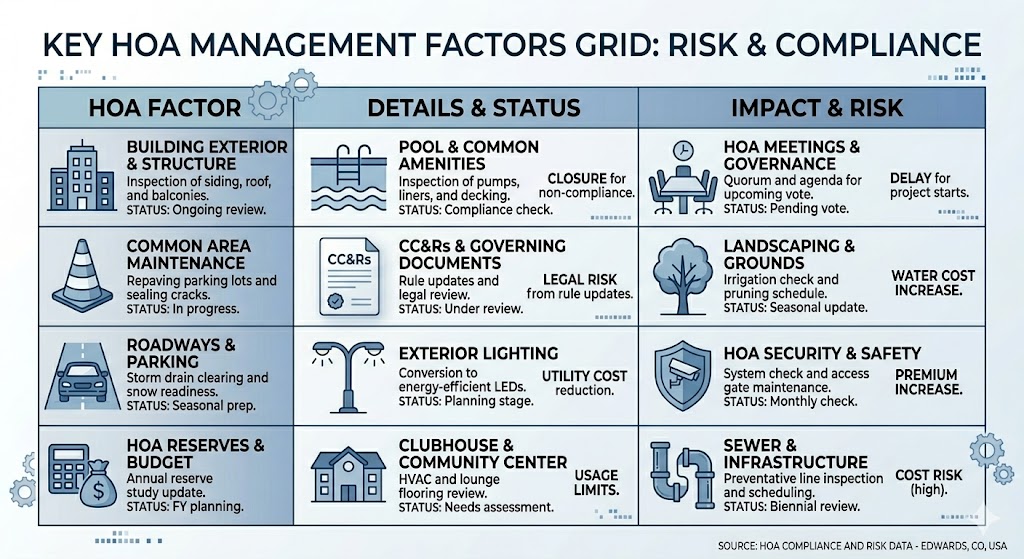
HOA insurance premiums aren't randomly assigned. Carriers rate against a defined set of factors — community type, claims history, construction, location, governing documents, and the rest of the table below. The same community will get materially different quotes depending on which factors land harder and which carriers see the risk most favorably. That's what makes online single-number estimates structurally wrong: they can't see your CC&Rs or your loss runs.
Premium Drivers
What Drives Your HOA Insurance Premium
HOA insurance pricing depends on dozens of factors specific to your community. Here's what drives premiums up or down — and why generic estimates almost always miss the mark.
| Rating Factor | Impact on Premium | |
|---|---|---|
| Number of units / association size | CriticalBiggest volume driver | |
| Building construction type (wood-frame vs masonry) | Significant15–40% swing | |
| Age of buildings | Notable10–25% swing | |
| Claims history (last 5 years) | Critical25–100%+ swing | |
| Amenities (pool, gym, elevators) | NotableEach adds to master policy premium based on risk exposure | |
| D&O limits selected | Critical200–400% swing on D&O premium | |
| Reserve adequacy | Notable10–20% swing | |
| Fidelity bond sized to reserves | NotableScales with reserves | |
| Location (wildfire, hurricane, hail zones) | Significant20–75% swing | |
| Ordinance & Law coverage | Minor5–15% swing | |
| Property manager risk profile | Notable10–20% swing | |
| Governing documents requirements | CriticalDetermines minimum limits |
No single factor decides the premium. The combination — and how the carrier weighs each factor against your CC&Rs — is what determines whether the renewal matches what the board budgeted.
A few notes on how to read the table. Claims history is weighted heavily — multiple water losses on record materially affect renewal pricing and carrier appetite. Location pricing reflects state-specific dynamics: HOA insurance in California runs different than Texas or Colorado because of litigation climate, construction costs, and statutes like Davis-Stirling. Coastal hurricane-zone markets like the Gulf and Southeast face their own specialty pricing for wind and named-storm exposure. And the master policy form itself — bare walls, all-in, or single entity — interacts directly with what unit owner HO-6 policies have to cover. See our deeper guide on master policy form vs unit owner policy.
The Four Policies Every HOA Carries
An HOA insurance program is rarely one policy. It's typically four lines of coverage stacked together — each addressing a different exposure, each priced separately, and each tied to specific language in the governing documents or state statute.
01
🏢Master Property
Covers the physical structures — roofs, walls, foundations, common-area systems, and shared spaces. The biggest line in the program. Whether the policy is "bare walls" or "all-in" is dictated by the CC&Rs and can swing premium materially.
02
⚖️General Liability
Third-party injuries and property damage on common grounds — slip-and-fall, broken stairs, visitor injuries. Standard limits run $1M per occurrence / $2M aggregate.
03
🛡️D&O Insurance
Protects board members personally against claims of mismanagement, breach of fiduciary duty, discrimination, or failure to maintain. Defense costs typically erode the limit dollar-for-dollar, so the policy form matters as much as the headline number.
04
🔐Fidelity Bond
Protects association funds against theft or embezzlement by anyone handling HOA money. State statutes and Fannie Mae guidelines typically require coverage equal to total reserves plus three months of assessments.
For a deeper look at how the master policy and unit owner HO-6 policies interact, read our guide on HOA master policy vs unit owner policy. For why D&O is the limit that tends to run out first, see why HOA boards need D&O coverage.
Walk through your master policy
Most boards never check the gap between their CC&Rs and their master policy until renewal.
We review the governing documents, compare what the policy actually covers against what the documents require, and walk the board through every gap before the next renewal cycle.
“The conversation boards rarely have isn't about the number. It's about the specific gaps between what the master policy covers and what the governing documents actually require.”
— Bobby Friel · Partner, Direct Insurance Services
Common Mistakes Boards Make
The same handful of governance gaps show up across nearly every HOA we review. They're rarely about the dollar figure on the dec page. They're about what the master policy covers versus what the governing documents actually require — and how often that gets verified.
What boards do
- ×Renew the master property limit at last year's value, assuming construction costs haven't moved much
- ×Skip D&O entirely or carry the bare-minimum limit because no one has been sued recently
- ×Size the fidelity bond by guess, not against reserves plus three months of assessments
- ×Auto-renew the package because the broker said the carrier offered the same rate
What a review surfaces
- ✓Replacement cost appraisal against current construction benchmarks, on a 2-year cadence built into the reserve study schedule
- ✓D&O limit calibrated to defense-cost erosion and board exposure, with defense-outside-the-limit structure where available
- ✓Fidelity bond sized to reserves + 3 months assessments per state statute and Fannie Mae guidance
- ✓Renewal compared against 30+ carrier markets — the spread tells the board whether the current carrier is still competitive
How to Lower Your Premium
Construction costs and litigation trends aren't levers boards can pull. How the community presents to carriers is. What moves rates in the right direction:
Maintain detailed maintenance records. Carriers want to see that a board is proactive about roof inspections, plumbing maintenance, and fire safety. Deferred maintenance is a red flag that pushes premium higher.
Right-size deductibles against the reserve fund. Higher deductibles reduce premium, but only work if reserves can absorb them at claim time. The exchange should be deliberate, not just "set it to whatever's cheapest."
Bundle policies thoughtfully. Carrying master property, GL, D&O, and fidelity through the same carrier (or the same agent who can package them) often unlocks multi-policy treatment. The consistency at renewal is the larger benefit.
Shop the market every year. Renewal markets typically show 15–30% spreads on the same community across carriers. Our HOA Insurance Risk Calculator gives boards a starting view of where their factors land before any quote conversation.

HOA Scenario
OPERATOR SCENARIO
Scenario
Imagine you're chairing a 75-unit HOA board. Your master policy renews in 90 days. You assume the existing coverage is fine — no claims have triggered a review in years, the property manager handles the broker conversation, and your reserves look healthy on paper.
What we did
What changes for you if a major loss hits before your next renewal? The replacement cost on your policy reflects construction values from when the policy was last reviewed. Today's rebuild cost is meaningfully higher. Coinsurance kicks in on partial losses. Inadequate limits on a total loss.
🎯 The Outcome
Could you walk into the next annual meeting and explain that gap to the homeowners — without it being the moment they lose trust in the board?
FAQ
Why don't you just tell me what HOA insurance costs?
Because no honest answer fits in a single number. A 30-unit condo conversion in Denver with aging plumbing, hardwood floors, and no sprinklers pays a completely different premium than a 150-unit garden-style PUD in Texas with HOA-maintained detached homes — and both pay differently than a 60-unit mid-rise in California with sprinklers, a pool, and a board that's been named in prior litigation. Every cost calculator online works by averaging those realities into one number. That number is wrong for almost every board it gets shown to. What's on this page instead: the twelve factors that actually move your master policy premium, what each factor actually does to your number, and the questions to ask your agent so your quote matches what you'll actually pay.
The Bottom Line
You've seen the twelve factors. The question worth asking isn't "what does HOA insurance cost" — it's "which of those twelve factors are driving our premium higher than it needs to be, and which are underinsured relative to what our CC&Rs actually require?"
If your association has a D&O policy separate from the master policy, the rating logic there is different and often over-bought. For communities with reserve fund depletion or prior special assessments, the policy structure has real effect on future assessments — check our HOA Board Insurance Guide for the structural questions every board should be asking. If your HOA hires contractors for maintenance or capital projects, make sure they carry proper contractor insurance. And if your association needs financing for a large capital project or reserve replenishment, HOA association financing and reserve loans can help spread the cost without a massive special assessment.
The fastest way to find out where the board stands? Use our HOA insurance risk calculator to see which of the twelve factors are working for the association and which are working against it. It takes about two minutes. Then we'll review against 30+ carriers and walk through the right structure for your specific community — not a budget estimate that won't survive renewal.
The board-level question
Not "what does HOA insurance cost." The right question is "which of the twelve factors are driving our premium higher than it needs to be, and which are underinsured relative to what our CC&Rs actually require?" The dec page is the headline. The endorsements and the governing documents are the story.
About the Author

Bobby Friel
Partner, Direct Insurance Services
Bobby Friel is a partner at Direct Insurance Services, where Patrick Henigan and the licensed team handle all quoting, policy reviews, and binding. Bobby runs the commercial division's marketing, content, and client outreach — helping contractors, HOA boards, restaurant owners, and commercial landlords across 29 states find the right coverage through Insurance Service 365.
Related Coverage
Explore Related Coverage Options
🏢 The Complete HOA Insurance Guide 2026
What every HOA board member needs to know about master policies, D&O coverage, fidelity bonds, and the coverage gaps that cost associations hundreds of thousands of dollars.
Read the Free Guide →
Ready When You Are
Ready When You Are
No pressure. No obligation. Just real quotes from 30+ carriers, reviewed on video so you understand exactly what you're buying.
Takes ~2 minutes · Contract review included · Video walkthrough on every option