
D&O Insurance for HOA Boards: What It Costs to Skip It

Last updated: May 26, 2026
Key Takeaway
D&O insurance is what stands between a homeowner's grievance and a volunteer board member's personal assets. The policy covers defense costs and settlements when board members are sued — selective enforcement, breach of fiduciary duty, failure to maintain, mismanagement of assessments. What most boards verify too late is the retroactive date: if it doesn't cover the period the homeowner is alleging the gap occurred, the policy doesn't respond.
What does D&O insurance cover for HOA boards?
D&O insurance covers legal defense costs and settlements when board members are sued for actions taken (or not taken) in their role as directors or officers. Common claims include breach of fiduciary duty, selective enforcement of rules, failure to maintain common areas, discrimination, and mismanagement of funds. It protects board members' personal assets — without it, they can be sued individually. The piece most boards verify too late is the retroactive date: a claims-made D&O policy only responds to claims tied to incidents after the retroactive date, so a lapse or a carrier switch with a moved retroactive date creates a coverage gap no board sees until the lawsuit arrives.
FOR HOA BOARDS
Volunteer board member. Personal lawsuit.
HOA boards are volunteer fiduciaries who can be named personally in lawsuits over routine governance decisions — pet policies, parking enforcement, architectural review denials, selective enforcement allegations. When a homeowner files suit, they can name the board AND the individual board members. The D&O policy is what stands between a homeowner's grievance and a volunteer's personal assets. The conversation most boards don't have isn't about what D&O costs. It's about what gets verified on the policy before the next claim arrives.
Volunteer Board Member. Personal Lawsuit.
HOA boards are volunteer fiduciaries who can be named personally in lawsuits over routine governance decisions — pet policies, parking enforcement, architectural review denials, selective enforcement allegations, special assessment disputes. When a homeowner files suit, they can name the board AND the individual board members. The volunteer hours, the good intentions, the consistent rule application — none of it stops the complaint from landing on three or four members' personal liability.
The D&O policy is what stands between a homeowner's grievance and a volunteer's personal assets. The conversation most boards don't have isn't about what D&O costs — it's about what gets verified on the policy before the next claim arrives. Retroactive date. Carrier-switch coverage. Tail coverage if the board ever lets the policy lapse. The certificate of insurance is the headline; the policy form is the substance. For the broader HOA insurance program context, see our HOA insurance cost breakdown and the master policy vs unit owner policy gap that often runs parallel to D&O exposure on the same board.
373K+
U.S. community associations as of 2025 — the universe of volunteer boards governing master policy, D&O, GL, and fidelity bond programs
Foundation for Community Association Research, 2025 Statistical Review
78.1M
residents living in U.S. community associations — every one of them a potential plaintiff if a board decision goes wrong
Foundation for Community Association Research, 2025 Statistical Review
$12.9T
property value held inside U.S. community associations as of 2024 — the fiduciary scale volunteer boards manage with their personal liability behind it
Foundation for Community Association Research, 2024 industry data
What D&O Actually Covers
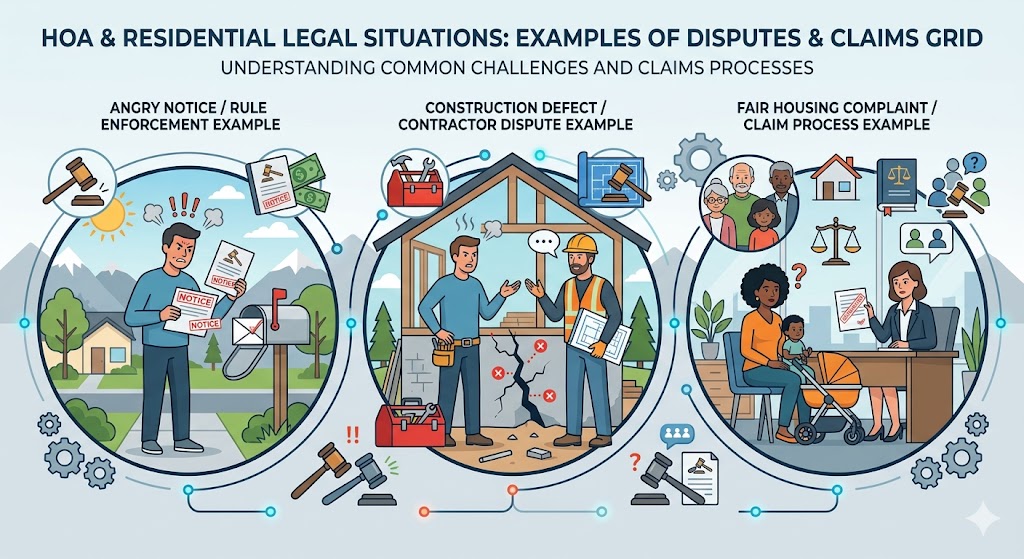
D&O — directors and officers — insurance protects the people who serve on your HOA board when they're sued for decisions they made (or didn't make) in their official capacity. The five claim categories that drive D&O response on HOA accounts:
01
⚖️Breach of Fiduciary Duty
A homeowner alleges the board mismanaged funds, failed to maintain reserves, approved a bad contract, or made decisions that decreased property values. Defending against the allegation costs money even when the board acted reasonably — fiduciary duty claims are the broadest category of D&O response on HOA accounts.
02
🚷Selective or Discriminatory Enforcement
Rules about noise, pets, parking, exterior modifications, rentals — any time a homeowner feels a rule was applied unfairly to them, it's a potential D&O claim. The lawsuit doesn't require proof of inconsistency; perception of unfairness is enough to trigger defense costs.
03
🏗️Failure to Maintain
When the board defers maintenance on roofs, siding, plumbing, or common areas and a homeowner suffers damage as a result, the board can be sued for negligence in the duty to maintain. The lawsuit names the board's decisions, not just the association.
04
👥Employment Practices Liability
When the HOA employs staff — maintenance workers, an on-site manager, a concierge — D&O with employment practices liability endorsement covers wrongful termination, harassment, and discrimination claims brought by employees. Without the EPL endorsement, those claims are excluded.
05
💰Mismanagement of Assessments and Reserves
Special assessments, reserve funding decisions, and budget allocation can all trigger lawsuits from unhappy homeowners who disagree with how their money is being spent. The board's discretion is exactly what the D&O policy was designed to defend.
What D&O doesn't cover is just as important as what it does. Property damage to the building (that's the master property policy). Bodily injury on common grounds (that's general liability). Theft of association funds (that's the fidelity bond). Construction defect repair costs (the carrier covers defense of the counter-suit, not the underlying defect). Intentional acts and known fraud. The D&O form is purpose-built for governance liability — the lawsuits volunteers face for serving on the board, not the property exposure the building itself carries.
What Drives Your HOA D&O Premium
D&O pricing on community association accounts is rated against a defined set of factors — community size, governance structure, master policy adequacy, litigation history, and the rest of the grid below. The same volunteer board can get materially different quotes depending on which factors land harder and which carriers see the community most favorably.
D&O Premium Drivers
What Drives Your HOA D&O Premium
D&O pricing on community association accounts is rated against governance signals, litigation history, and master program adequacy. Here's what underwriters actually evaluate when sizing the premium for a volunteer board.
| Rating Factor | Impact on Premium | |
|---|---|---|
| Community size / unit count | SignificantVolume driver — premium scales with unit count and assessment base | |
| Self-managed vs professionally managed | SignificantGovernance signal — professional management correlates with lower claim frequency | |
| Master policy adequacy | SignificantUnder-insured property programs correlate with under-resourced governance generally | |
| Recent litigation history | CriticalPrior claims drive renewal pricing; multiple claims narrow carrier appetite | |
| Board turnover rate | NotableHigh turnover signals governance instability to carriers | |
| Governing-document specificity | NotableClear CC&Rs reduce selective-enforcement claim risk; vague rules increase it | |
| Annual budget and reserve adequacy | NotableReserve gaps and assessment-allocation disputes drive claim frequency | |
| Employment practices liability inclusion | NotableHOAs with paid staff need EPL endorsement; otherwise claims excluded | |
| Retroactive date depth | CriticalThe single most consequential structural feature of a claims-made D&O policy | |
| State CC&R legal climate | SignificantCalifornia (Davis-Stirling) and other regulated states drive higher claim frequency |
No single factor decides the premium. The combination — and especially how the retroactive date interacts with the board roster history — is what determines whether the policy actually responds when a claim arrives.
A few notes on how to read the table. Community size is the volume driver. Self-managed associations rate harder than professionally managed ones because professional management is a governance signal carriers use to predict claim frequency. Master policy adequacy matters because under-insured property programs correlate with under-resourced governance generally. And the retroactive date — the single most consequential structural feature of a claims-made D&O policy — determines whether the policy responds to a claim tied to an incident that happened before the current carrier wrote the policy.
Claims-Made and the Retroactive Date
Most D&O policies are claims-made, which works differently from occurrence-form coverage that GL typically runs on. Two distinctions matter:
Occurrence policy: covers incidents that happen during the policy period, regardless of when the claim is filed. An incident in 2026 with a lawsuit in 2028 still responds against the 2026 policy.
Claims-made policy: covers claims filed during the policy period, as long as the underlying incident happened after the policy's retroactive date. A policy that started in 2024 with a 2024 retroactive date will respond to a 2026 claim tied to a 2025 incident. The same policy will NOT respond to a 2026 claim tied to a 2023 incident — that incident predates the retroactive date.
The practical implications for HOA boards: don't let D&O lapse. If the policy cancels and a lawsuit lands the next month for something that happened last year, there's no coverage. When switching carriers, the new carrier needs to match or extend the retroactive date — moving it forward creates a gap that the prior policy can't fill once it's gone. And if the board decides to drop D&O entirely (which would be a serious governance error), the conversation should include tail coverage — an extended reporting period that keeps the policy responsive to claims filed after the policy ends.
Before the next board election
Most board members don't check the D&O retroactive date until after a homeowner files.
We pull your current D&O declarations, verify the retroactive date covers your board tenure, and walk through the gap before someone names a volunteer personally in a lawsuit.
“When a homeowner sues the board, they can — and do — name individual board members personally. That means a volunteer's personal assets are on the line, not just the association's.”
— Bobby Friel · Partner, Direct Insurance Services
Without D&O vs. With Proper D&O
The volunteer-vs-asset-exposure choice isn't binary. Boards either have proper D&O coverage with the retroactive date verified, or they have exposure they haven't mapped yet. Five places where the difference shows up:
Board Serves Without Proper D&O
- ×Personal assets exposed in volunteer lawsuits
- ×No defense funds when a homeowner names members personally
- ×Settlement comes out of board member pockets
- ×Retroactive date irrelevant — no coverage in either direction
- ×Volunteers refuse to serve after the first claim hits the prior board
Board Serves With Proper D&O
- ✓Personal assets shielded by carrier defense from first complaint
- ✓Defense costs covered from the moment the homeowner attorney calls
- ✓Retroactive date verified against full board roster history
- ✓Tail coverage / extended reporting period considered at every carrier switch
- ✓Volunteers know the association protects them, not just itself

HOA Scenario
OPERATOR SCENARIO
Scenario
Imagine you're three years into your second term as HOA board president. A homeowner files suit against the board, naming you and two other volunteers personally. The allegation: selective enforcement of the pet policy. The board's actions were defensible and consistent — but the lawsuit doesn't care about that yet.
What we did
What changes for you if your association's D&O policy lapsed for thirty days last year between carriers? Or if the new carrier's retroactive date doesn't cover the period the homeowner is alleging the enforcement gap occurred?
🎯 The Outcome
Could the personal liability you accepted when you joined the board already extend to a claim window your current D&O policy doesn't actually cover?
FAQ
What's the difference between the master policy's director liability extension and a standalone D&O policy?
Some master property policies include a small director and officer liability endorsement bundled into the package. That endorsement is rarely enough on its own — it typically carries low limits (often $25K–$100K aggregate), excludes employment practices liability, and runs on a different claims-made structure than a standalone D&O. A standalone D&O policy is purpose-built for governance liability with limits sized to the community, dedicated defense allocation, and broader claim categories. Boards that rely on the master endorsement alone usually discover the gap when the first homeowner files suit.
Does our D&O carry over if we switch carriers mid-term?
Only if the new carrier matches or extends the retroactive date. A new carrier issuing a policy with a current-date retroactive date creates a gap — the prior carrier no longer covers claims filed after the prior policy expires, and the new carrier doesn't cover incidents that predate the new retroactive date. The fix is to confirm the new policy carries the prior retroactive date forward before the switch finalizes, or to purchase tail coverage on the outgoing policy.
Are former board members still covered by the current policy?
Yes — as long as the lawsuit alleges actions taken during their tenure AND the incident date falls after the policy's retroactive date AND the policy is in force when the claim is filed. The "claims-made" structure means it's the policy in force on the filing date that responds, not the policy in force during the tenure. This is why retroactive date depth matters so much: a deep retroactive date covers the full tenure of every former member who served under the association.
What does the retroactive date actually mean — and how do we know if ours is right?
The retroactive date is the earliest incident date the policy will respond to. A 2020 retroactive date means the policy covers claims filed today for incidents that happened any time after January 1, 2020. A 2024 retroactive date on a 2026 policy means anything pre-2024 is uncovered, even if the current board carried policies continuously through that period. The right retroactive date is one that covers the tenure of every current AND likely-to-be-named former board member. Pull your D&O declarations and check the retroactive date against your board roster history. If there's a gap, that's the conversation to have with the current carrier or in the next renewal review.
The Bottom Line
D&O is the policy that decides whether a volunteer board member's personal assets are on the line in the next homeowner lawsuit. Before the next renewal, the right question isn't what it costs — it's whether the retroactive date actually covers the tenure of every volunteer who signs up to serve. The board members the policy was bought for include the ones who served two years ago and the ones who'll join the board next election.
For the broader HOA program — master property, GL, D&O, and fidelity bond — read our HOA insurance cost breakdown. For the parallel coverage boundary that runs alongside D&O exposure, see master policy vs unit owner policy. The HOA Board Insurance Guide covers the full four-policy program every association carries. And the HOA Insurance Risk Calculator walks through where the factors land before the renewal conversation.
If your HOA hires contractors for maintenance, repairs, or renovation projects, make sure every vendor carries proper general liability insurance with the HOA named as additional insured. For HOAs that own rental units or commercial space within the community, commercial property coverage may also be needed. State-specific HOA insurance climates differ — boards in Arizona and other Sun Belt states face unique exposure from pools, outdoor amenities, and storm damage. And if a large capital expense is on the horizon, special assessment financing and HOA reserve loans can spread the cost and reduce homeowner pushback.
The board member's question
Not "how much does D&O cost." The right question is "does the retroactive date on our current policy actually cover the tenure of every volunteer who served on this board — and the ones likely to be named when the next homeowner files?" The certificate is the headline. The retroactive date and the carrier-switch continuity are the substance.
About the Author

Bobby Friel
Partner, Direct Insurance Services
Bobby Friel is a partner at Direct Insurance Services, where Patrick Henigan and the licensed team handle all quoting, policy reviews, and binding. Bobby runs the commercial division's marketing, content, and client outreach — helping contractors, HOA boards, restaurant owners, and commercial landlords across 29 states find the right coverage through Insurance Service 365.
Related Coverage
Explore Related Coverage Options
🏢 The Complete HOA Insurance Guide 2026
What every HOA board member needs to know about master policies, D&O coverage, fidelity bonds, and the coverage gaps that cost associations hundreds of thousands of dollars.
Read the Free Guide →
Ready When You Are
Ready When You Are
No pressure. No obligation. Just real quotes from 30+ carriers, reviewed on video so you understand exactly what you're buying.
Takes ~2 minutes · Contract review included · Video walkthrough on every option