
Contractor Insurance Guide 2026: What Every Contract Demands
The six policy lines every contractor carries, the COI requirements that decide whether you start the job, and the gaps that lose contracts you spent months winning. Written by Bobby Friel and the Direct Insurance Services team.

Bobby Friel
Partner, Direct Insurance Services
Bobby Explains
Watch: Contractor Insurance Explained
Everything you need to know about contractor coverage — in under 2 minutes.
For Operators
Who This Guide Is For
- General contractors bidding on commercial projects with strict COI requirements who need their insurance to clear compliance on the first submission
- Specialty trade contractors (electrical, plumbing, HVAC, roofing, concrete, etc.) managing jobsite insurance compliance across multiple GCs and projects
- Contractors renewing policies who want to verify their coverage actually matches the work they do and the contracts they sign
- Contractors who have had COIs rejected and don’t understand why — or how to prevent it from happening again
Most contractors don’t read a guide on commercial insurance because they’re curious. They read one because something just happened — a renewal came in higher than last year, a GC’s contract showed up with two pages of requirements they don’t recognize, a COI got kicked back, or they’re bidding work bigger than anything they’ve taken on before and aren’t sure the policy stretches to cover it.
~8M
U.S. construction industry workforce
BLS Industries at a Glance — Construction
1 in 5
Workplace fatalities that occur in construction
BLS Census of Fatal Occupational Injuries
60%
Construction worker deaths attributed to the OSHA Fatal Four (falls, struck-by, electrocutions, caught-in/between)
OSHA Construction Focus Four
Case Study: Commercial Roofing Contractor — Mid-Size GC Subcontract

Contractor Scenario
OPERATOR SCENARIO
Scenario
Commercial roofing contractor wins a six-figure subcontract with a regional general contractor — the kind of relationship the contractor had been working toward for two years. The signed contract runs 18 pages of insurance requirements: additional insured for both ongoing and completed operations, waiver of subrogation, primary and non-contributory wording, per-project aggregate, completed operations coverage extended through the warranty period.
The contractor forwards the requirements to their current agent on a Thursday. The agent issues a COI from the existing policy on the spot — same coverage that’s been on the account for three renewals.
The GC’s compliance team rejects the COI the next morning. Three problems flagged: the additional insured endorsement on file is the wrong form for ongoing operations, the waiver of subrogation isn’t on the policy at all, and the primary and non-contributory language is missing entirely. Project start is Monday. Endorsement turnaround on the existing carrier runs three to five business days.
What we did
Pulled the contract’s insurance schedule and matched it line-by-line against the existing policy’s declarations and endorsement schedule. Identified the three missing items the GC’s compliance team had flagged plus two additional requirements the contractor’s prior agent hadn’t surfaced. Confirmed which gaps could be patched on the existing carrier inside the timeline and which couldn’t. Sourced replacement coverage from a carrier whose standard endorsement package matched the GC’s contract requirements out of the gate — no per-project endorsement filings needed.
🎯 The Outcome
Replacement coverage bound before the Monday start. COI cleared the GC’s compliance review on first submission with all five endorsements in place. The contractor kept the project, kept the relationship, and finished the engagement on a policy that actually matches what the rest of their commercial contracts require — instead of a policy that needed an emergency rebuild every time a contract hit compliance.
The Six Lines Every Contractor Carries
Most contractors carry one or two of these. Fully protected contractors carry all six. Here's what each line covers, in operator vocabulary — without the fabricated scenarios.
01
🛡️General Liability
Third-party bodily injury and property damage from your work — the line GCs require first. Doesn’t cover employees (workers comp), vehicles (auto), or design errors (E&O). Standard limits $1M per occurrence / $2M aggregate; commercial work increasingly demands $2M/$4M.
02
👷Workers Compensation
Medical and lost-wage benefits for employees injured on the job. Statutorily required in nearly every state once you have W-2 employees. Rates vary sharply by trade — high-fall-exposure trades like roofing carry far higher rates than lower-risk trades like painting.
03
🚛Commercial Auto
Vehicles used for work. Personal auto policies typically exclude business use, so any truck hauling tools, materials, or crew needs this line. Pair with hired and non-owned auto (HNOA) to cover employees driving their own vehicles for the business. $1M combined single limit is the common floor.
04
🔧Tools & Equipment (Inland Marine)
Covers tools and equipment wherever they go — shop, in transit, on the jobsite. Standard property policies leave gaps because they only cover fixed locations. Choose replacement cost over actual cash value, and inventory annually.
05
📐Professional Liability (E&O)
Design-build, spec, or consulting errors. GL doesn’t respond to professional mistakes. Needed by design-build contractors, contractors with design responsibility in their scope, and anyone whose professional judgment is in the contract.
06
☂️Umbrella / Excess Liability
Additional limits sitting on top of your GL, auto, and (often) employers liability. Commercial GC contracts increasingly require $5M+ in total liability — $1M–$5M umbrella is the common range.
Section summary
Certificate of Insurance Requirements Explained
A (COI) is the document that proves you have insurance. It lists your policy types, coverage limits, effective dates, and named certificate holders. Every GC, property owner, and project manager will require one before you set foot on a jobsite. For a complete overview, read our guide on what a Certificate of Insurance is and why it matters.
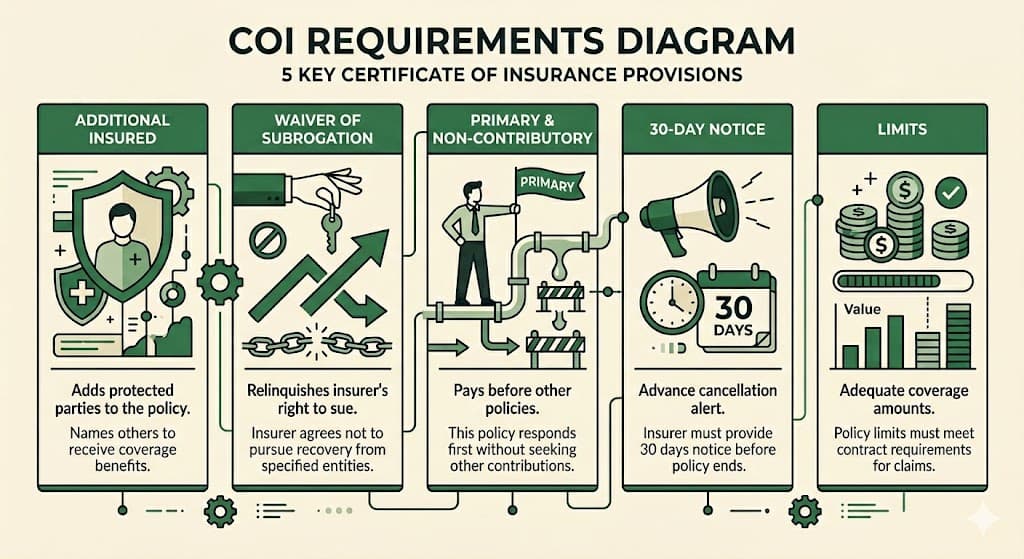
The 5 Most Common COI Requirements
1. Additional Insured (AI)
The GC, property owner, or other specified party is named as an on your GL policy. This means your policy extends coverage to them for claims arising from your work. Most contracts require this, and most COI rejections happen because the additional insured endorsement is missing or incorrectly worded. A blanket additional insured endorsement covers any party automatically without needing individual additions.
2. Waiver of Subrogation
Your insurance carrier agrees not to pursue (subrogate against) the named party for damages it has paid on a claim. Without this waiver, your carrier could pay a claim and then sue the GC to recover the money — which defeats the purpose of the GC requiring insurance from you in the first place. Like additional insured, a blanket endorsement saves time and prevents rejections.
3. Primary and Non-Contributory
Your policy pays first on any claim, and the GC's policy doesn't have to contribute. Without this language, both your policy and the GC's policy might share the claim — which raises the GC's loss history and premiums. GCs require this so their policy is never touched by claims arising from your work.
4. 30-Day Notice of Cancellation
Your carrier must notify the certificate holder if your policy is cancelled, non-renewed, or materially changed. This protects the GC from unknowingly having an uninsured on their project. Note: many carriers now limit this to “endeavor to provide” notice, which is weaker. Check whether your carrier provides mandatory or best-efforts notice.
5. Specific Minimum Limits
Contracts specify minimum coverage limits — often $1M/$2M for GL and $1M for auto. Larger commercial projects may require $2M/$4M for GL and $5M in total liability (including umbrella). If your COI shows limits below the contract minimum, it will be rejected regardless of whether every other requirement is met.
Why COIs Get Rejected
Has your COI ever been rejected by a GC? Do you know which of these requirements was missing — and why your agent didn't catch it before the contract was signed?
- ×Missing additional insured endorsement (most common)
- ×Missing waiver of subrogation
- ×No primary and non-contributory language
- ×Limits below the contract minimum
- ×Expired policy or incorrect policy dates
- ×Wrong named insured (business name doesn't match the contract)
Correcting a rejected COI typically takes 1–3 business days — long enough to lose a job. The solution is to build your policy with blanket endorsements from day one so every COI request clears immediately. For more on this process, read why your COI keeps getting rejected and how contractors get contract-ready COIs.
Section summary
“The contractors whose COIs don't get rejected aren't the ones whose agents bound fastest — they're the ones whose agents read the contract first.”
— Bobby Friel · Partner, Direct Insurance Services
The 8 Mistakes Contractors Make With Insurance
These are the coverage gaps and process failures our team sees repeatedly across the contractor policies we review. Each one is preventable. Each one has cost a contractor real money or a real job.
📝 When was the last time your agent actually read your biggest contract?
Most insurance agents quote contractors based on a generic application: trade class, revenue, payroll, done. They never see the contracts that dictate your actual insurance requirements. The result? Your policy is built to satisfy a standard checklist, not the specific endorsements, limits, and language your GC contracts demand. When you submit your COI and the compliance department flags three missing requirements, the problem isn’t your COI — it’s that your agent built your policy without reading the document that defines what it needs to include.
How to fix this: Before your next renewal, send your three largest contracts to your insurance agent. Ask them to compare the insurance requirements in each contract against your current policy. If they can’t or won’t do this, that tells you everything you need to know about their process.
A significant share of the contractor policies our team reviews carry at least one gap between the policy and the contractor’s actual contract requirements.
📋 Have you confirmed your COI will clear before the contract is signed?
Contractors routinely sign contracts without verifying whether their current insurance policy can produce a compliant COI. They assume the COI is just paperwork — something the agent handles after the deal is done. But COI requirements are contractual obligations. If your policy can’t produce a COI with the required additional insured endorsement, waiver of subrogation, and primary/non-contributory language, you’ve signed a contract you can’t fulfill. And you won’t find out until the GC’s compliance department rejects your COI on day one.
How to fix this: Send the insurance requirements section of every new contract to your agent before you sign. Ask them to confirm in writing that your current policy can produce a compliant COI. If endorsements need to be added, get them added before the contract is executed.
COI rejection is one of the most common reasons contractors lose jobs they’ve already been awarded. Most rejections are for missing endorsements that take 1–3 days to add.
⏱ Do you know how long it takes to correct a rejected COI — and what that costs you?
When a COI is rejected, the fix isn’t instant. If the rejection is for a missing endorsement — like additional insured or waiver of subrogation — that endorsement has to be requested from your carrier, reviewed by underwriting, approved, and issued. This process takes 1–3 business days on a good day. During that time, the GC either delays the project start (costing everyone money) or replaces you with a competitor whose COI clears immediately. The cost of a rejected COI isn’t a small endorsement fee — it’s the contract you lose while waiting.
How to fix this: Build your policy with blanket additional insured and blanket waiver of subrogation endorsements from day one. These blanket endorsements cover any party without requiring individual additions, so any COI request can be fulfilled immediately.
Contractors who use blanket endorsements see meaningfully fewer COI rejections than those who add endorsements project by project.
👷 Are your subcontractors’ COIs actually on file and current?
If a subcontractor works on your job without valid insurance and someone gets hurt, the claim flows uphill — to you. Your GL policy, your workers comp policy, and your claims history take the hit. Most contractors require subs to provide COIs at the start of the relationship and never check again. Policies expire, get cancelled, or have limits reduced. That COI from 18 months ago may be worthless. The GC is holding you responsible for sub compliance, and you’re not tracking it.
How to fix this: Create a sub tracking system. At minimum, collect updated COIs from every sub annually and verify they include GL, workers comp, and additional insured naming your company. Set calendar reminders 30 days before each sub’s policy expiration.
A single uninsured subcontractor claim can drive a meaningful premium increase at renewal and disqualify you from bidding on projects requiring clean loss runs.
🚚 Does your auto policy cover vehicles your employees drive for work?
This is one of the most expensive gaps in contractor insurance. If an employee drives their personal vehicle to a job site and causes an accident, your commercial auto policy won’t cover it — because you don’t own the vehicle. And their personal auto policy likely excludes business use. You need hired and non-owned auto (HNOA) coverage to fill this gap. HNOA covers liability for vehicles your employees drive for work but that you don’t own. Without it, you’re exposed to claims from any employee who drives to a site in their own car.
How to fix this: Add hired and non-owned auto (HNOA) coverage to your commercial auto or GL policy. It’s a modest premium that fills one of the most common coverage gaps for contractors.
Auto liability claims for crew injuries can range widely. Without HNOA coverage, these come directly out of the contractor’s pocket.
🔧 Is your tools coverage set at replacement cost or actual cash value?
Many contractors have inland marine (tools and equipment) coverage without knowing whether it pays replacement cost or actual cash value (ACV). The difference is enormous. Replacement cost pays what it costs to buy the same tool new today. ACV deducts depreciation — so a five-year-old saw might pay out a fraction of what it costs to replace. After a theft or fire, the gap between what ACV pays and what you spend to replace the tools can be the difference between getting back to work next week and not.
How to fix this: Check your inland marine policy declarations. If it says “actual cash value,” ask your agent to switch to replacement cost. The premium difference is modest compared to the difference in claim payout.
ACV tools coverage pays out meaningfully less than replacement cost after depreciation. The gap shows up at the worst possible time — right after a theft or fire when you need to replace tools to keep working.
☂ Do you have umbrella coverage adequate for the projects you’re bidding?
Many contractors carry the minimum GL limits ($1M/$2M) and no umbrella. Then they bid on a commercial project that requires $5M in total liability coverage and scramble to figure out why they can’t get a compliant COI. Even if your current projects don’t require it, umbrella coverage is the cheapest way to protect your business from catastrophic claims. A single serious injury on a job site can generate a claim that exceeds $2M — and if your GL is capped at $2M aggregate, you’re personally liable for everything above that.
How to fix this: Review the insurance requirements of the largest projects you want to bid on in the next 12 months. Set your umbrella limit to cover those requirements. For most commercial contractors, $2M–$5M in umbrella coverage provides adequate protection.
A $1M umbrella is typically a small premium relative to the additional coverage it provides — less than 1% of the limit it adds.
📊 When was the last time anyone audited your coverage against your actual work?
Contractors’ businesses change constantly. You add employees, take on new trade classes, buy equipment, start bidding on larger projects, or expand into new states. But your insurance policy stays the same as it was the day it was written — unless someone actively updates it. The policy that was right for a two-person residential crew is dangerously inadequate for a 15-person commercial operation. Premium audits will catch payroll and revenue changes, but they don’t catch coverage gaps. Only a deliberate policy review against your current operations does that.
How to fix this: Schedule an annual coverage audit with your agent. Bring your current employee roster, payroll by job class, vehicle list, equipment inventory, largest contracts, and revenue projections. Compare all of this against your current policy and update accordingly.
Contractors who conduct annual coverage audits surface gaps before claims time — instead of after, when the cost of finding them goes up sharply.
Section summary
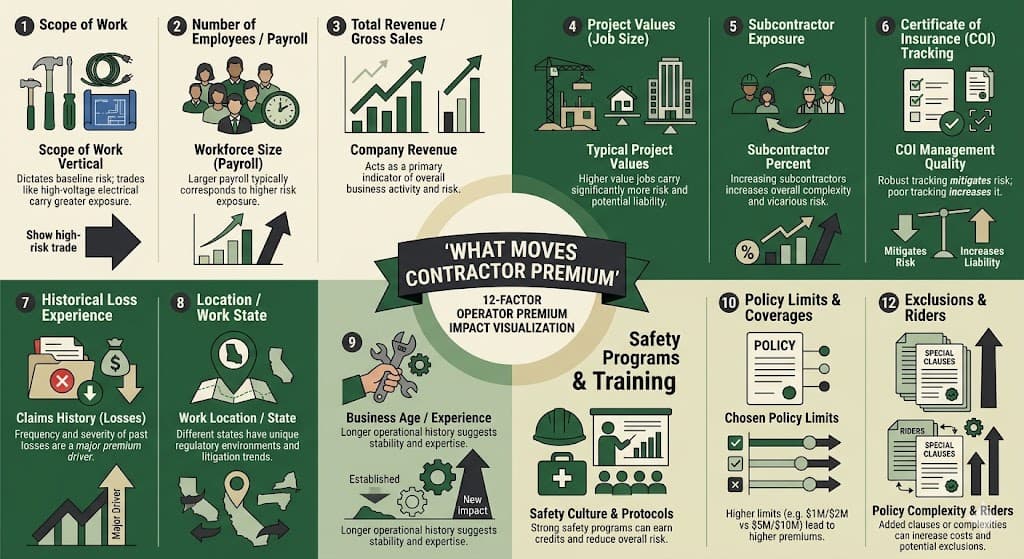
Premium Drivers
What Drives Your Contractor Insurance Premium
Commercial insurance pricing depends on dozens of factors specific to your business. Here's what moves premiums up or down — and why generic ‘starting at $X/month’ quotes almost always fail to match your actual risk.
| Rating Factor | Impact on Premium | |
|---|---|---|
| Trade / class code | CriticalBaseline risk — high-fall and hot-work trades carry the heaviest rating. | |
| Annual payroll | CriticalThe primary workers comp driver — scales directly with crew size. | |
| Claims history / EMR | CriticalBelow 1.0 wins jobs; above 1.0 can disqualify you from bidding. | |
| Annual revenue | SignificantA primary indicator of overall business activity and exposure. | |
| Subcontractor use | SignificantHigher sub percentages add vicarious liability and complexity. | |
| Coverage limits required by contracts | SignificantGC contract requirements drive the limit structure your policy must carry. | |
| State / jurisdiction | SignificantRegulatory environment, litigation climate, and prevailing wage rules vary sharply. | |
| Project types (residential vs commercial) | SignificantCommercial work carries higher limits and stricter compliance than residential. | |
| Years in business | NotableLonger operational history signals stability and underwriting confidence. | |
| Number of vehicles | NotableEach vehicle adds rated exposure to commercial auto. | |
| Tools & equipment value | NotableInland marine coverage scales with the inventory it protects. | |
| Safety program / certifications | NotableDocumented safety programs can earn credits and lower overall rates. |
A complete contractor insurance program typically includes these policy lines:
| Coverage | Purpose | Typical Limits | |
|---|---|---|---|
| General Liability | Third-party injury and property damage from your work. | $1M occurrence / $2M aggregate | |
| Workers Compensation | Employee injuries and lost-wage benefits. | State statutory minimums | |
| Commercial Auto + HNOA | Business vehicles and employee-owned vehicles used for work. | $1M combined single limit | |
| Tools & Equipment (Inland Marine) | Theft, damage, and loss of tools wherever they go. | Replacement cost of inventory | |
| Professional Liability / E&O | Design errors and consulting mistakes. | $500K–$2M depending on work type | |
| Umbrella / Excess Liability | Additional limits above the underlying lines. | $2M–$10M based on contract requirements |
Every contractor program is different. Rather than guessing from a generic table, the right next step is a contract-first review against your current policy.
For a deeper trade-by-trade breakdown, read our complete contractor insurance cost breakdown for 2026.
Section summary
Before the next contract
Most contractor policies are quoted from a generic application — without anyone reading the contract.
We pull your three largest contracts, walk through the insurance requirements against your current policy, and surface the gaps before the next bid window closes.
State-Specific Considerations
Contractor insurance requirements vary significantly by state. Licensing, workers comp mandates, and COI standards differ depending on where you operate. Here are a few notable examples:
California
California has the strictest licensing and COI requirements in the country. The Contractors State License Board (CSLB) requires a bond for all licensed contractors. is mandatory for any contractor with W-2 employees — no exceptions. Commercial projects in Los Angeles, San Francisco, and San Diego have increasingly strict COI compliance requirements, often demanding $2M/$4M GL limits and extensive additional insured language. California contractor insurance requirements
Texas
Texas is generally contractor-friendly with fewer state licensing requirements, but commercial projects in Dallas, Houston, Austin, and San Antonio have strict COI requirements that rival California. Workers comp is technically optional in Texas, but virtually every GC contract requires it, and going without exposes you to direct lawsuits from injured employees (Texas non-subscribers lose most common-law defenses). Texas contractor insurance considerations
Colorado
Mountain region claims (snow load, hail, altitude-related material failures) affect contractor insurance pricing significantly. Colorado's commercial project COI requirements are similar to California's, particularly in Denver, Colorado Springs, and resort communities. The state's construction defect laws are among the most plaintiff-friendly in the country, making adequate GL and coverage critical. Colorado contractor insurance requirements
Pennsylvania & Illinois
Strong union presence in both states affects prevailing wage requirements and workers comp rates. Pennsylvania and Illinois have among the highest workers comp rates in the country, particularly for high-risk trades like roofing and demolition. Union projects often have additional insurance requirements beyond standard GC contracts. Pennsylvania contractor insurance | Illinois contractor insurance
We serve contractors across 29 states, and our agents understand the specific licensing, bonding, and insurance requirements in each one. See all 29 states we serve to find state-specific information for your business.
Frequently Asked Questions
How much contractor insurance do I actually need?
What’s the difference between general liability and professional liability for contractors?
Do I need workers comp if I only have 1099 subcontractors?
Why does my COI keep getting rejected?
How do I make sure my COI clears on the first try?
Does my personal auto policy cover me when I use my truck for work?
Is contractor insurance cheaper if I work residential vs commercial?
How do I know if my tools coverage is adequate?
Do I need umbrella coverage if I already have GL limits of $1M/$2M?
What documents do I need to get a contractor insurance quote?
We Verify Before You Bind

What Most Agents Do
- ×Quote from a generic application
- ×Bind on price and speed
- ×Never ask to see your contracts
- ×Find out about endorsement gaps when the COI bounces
- ×Treat the COI as paperwork, not a contract requirement
What We Do
- ✓Read your three largest contracts first
- ✓Match coverage to what the GC actually requires
- ✓Confirm AI, waiver of subrogation, and primary & non-contributory before bind
- ✓Surface gaps before the bid window closes
- ✓Treat the COI as the thing that decides whether you start the job
Most insurance agents quote contractors based on a generic application: trade class, revenue, payroll, done. They never see the contracts that dictate your actual insurance requirements. We do it differently. Before we issue a proposal, we read your contracts. We verify COI requirements against your policy. We confirm that additional insured language, waiver of subrogation, and primary/non-contributory endorsements match what your GCs require.
Then we present our findings to you on a video call, in plain English. No jargon, no pressure — just a clear explanation of where your coverage stands, where the gaps are, and what your options are. This is what we call a consultative review, and it's included at no cost for every contractor client.
When we say your policy matches your contract requirements, it does — because we've read both.
Watch Patrick Walk Through a Real Contractor Policy Review
See exactly what a consultative review looks like — from contract analysis to coverage recommendation — in under 10 minutes.
This consultative approach is the same process we bring to HOA insurance for contractors working on association properties and commercial property insurance for contractors who own their shop or yard. For contractors handling food service buildouts, we also handle restaurant insurance for contractors handling food service buildouts.
Need equipment financing or working capital? Equipment financing and working capital loans for contractors may be an option worth exploring.
Bottom line
Contractor insurance isn't built from a generic application. It's built from your contracts. The right coverage program is the one matched to what the next GC contract will actually demand — not the one the cheapest agent could quote in 10 minutes.

Ready to Take the Next Step?
Whether you're reviewing your current coverage, bidding on a new project, or fixing a COI rejection, these tools will help you make informed decisions.