
The Complete Commercial Landlord Insurance Guide 2026: What Every Building Owner Must Know Before Renewal
A free, no-email-required guide covering building owner coverage, loss of rents, vacancy exclusions, tenant improvements, and the coverage gaps that surface at claim time for multi-tenant building owners. Written by Bobby Friel and the Direct Insurance Services team.

Bobby Friel
Partner, Direct Insurance Services
Watch
Commercial Landlord Insurance Explained
Why your tenant's insurance doesn't protect your building — and what does.
Who this is for
Who This Guide Is For
- Commercial property owners with 1–20+ buildings (strip malls, office buildings, industrial, mixed-use) who want to understand what their policy actually covers
- Real estate investors who own commercial property and lease it to business tenants — and need to know where their insurance stops and the tenant’s begins
- Property management companies handling insurance compliance for commercial landlords and tenant COI verification
- Building owners reviewing policies at renewal and wondering whether they’re actually protected against the risks they face every day
What brought you here?
Most commercial building owners don't pick up a guide on lessor's risk insurance because they're curious. They picked it up because something just happened — a renewal proposal landed 22% above last year and the asset manager flagged it before sign-off, a tenant vacated unexpectedly and the loss-of-rents limit hasn't been re-evaluated against current rent roll in years, a new 10-year lease was signed with insurance requirements the current policy doesn't match, or a lender requested updated certificates and the current carrier can't produce the language demanded.
5.9 million
commercial buildings in the U.S. commercial building stock
EIA Commercial Buildings Energy Consumption Survey (CBECS)
$104 billion
U.S. commercial multi-peril insurance direct premiums written
Insurance Information Institute (III)
~21%
rise in non-residential construction costs over a recent three-year window
Turner Building Cost Index
Case Study: 95,000 sq ft Multi-Tenant Complex — 22% Renewal Halted at Sign-Off

Building Owner Scenario
OPERATOR SCENARIO
Scenario
Owner of a ~95,000 sq ft multi-tenant retail/office complex (TIV ~$8M, eight tenants including a restaurant and a medical office) receives a renewal proposal 22% over the expiring year. The owner's asset manager flags it for review before sign-off.
Loss-of-rents limit unchanged for four years. Rents have risen approximately 30% across the rent roll during that window. Two tenant COIs lapsed without the property manager catching the gap. Building insured near purchase price, not replacement cost. Ordinance-or-law coverage limit set at original underwriting and never re-evaluated.
The current broker's renewal proposal is silent on the rent roll growth, silent on the COI lapses, silent on the construction-cost inflation. The 22% increase is presented as a market-driven adjustment to the same coverage structure that's been auto-rolling for four cycles.
What we did
Read all eight leases and cross-checked tenant COIs against the underlying lease insurance requirements. Identified the two lapsed COIs and the three additional COIs missing the lease-required additional-insured language. Re-priced the building to current replacement cost using current construction cost data for the market — surfaced approximately 28% under-insurance against current rebuild cost. Re-sized loss-of-rents to 14 months of current rent roll (matched to a realistic rebuild timeline for a building of this construction class). Added equipment-breakdown coverage for the shared HVAC and elevators. Added a vacancy endorsement covering an upcoming unit turnover the lease office had flagged.
🎯 The Outcome
Bound a program matched to actual lease obligations rather than auto-rolling the prior structure. Closed the replacement-cost gap before any covered loss could expose it. Brought the two lapsed tenant COIs into compliance and corrected the three with non-compliant additional-insured language. The building owner approved a rebuilt program at renewal — not a rubber-stamp on a 22% increase to coverage that didn't reflect the building's current rent roll, current construction costs, or current lease obligations.
The Eight Lines Every Commercial Building Owner Carries
Most commercial building owners carry a basic property policy and GL. A fully-built program carries all eight lines below — each one tied to what the leases, the tenant mix, and the current rent roll actually demand. For an overview, read our guide on Commercial Landlord Insurance: What Owner Policies Skip.
01
🏢Commercial Property Policy (Lessor’s Risk form)
What it covers: Buildings, structures, common areas, shared mechanical, owner-controlled improvements. Tenant-improvement-and-betterment treatment depends on lease language. Limits: 100% of current replacement cost — not market value, not loan balance, not purchase price. The question this answers when something goes wrong: When a covered loss exceeds your replacement cost limit, where does the gap come from — owner reserves, lender renegotiation, or a partial-rebuild that triggers ordinance-or-law gaps?
02
💰Loss of Rents (Business Income for Landlords)
What it covers: Replacement of rental income when the building is untenantable after a covered loss. Coverage period typically 12-24 months. Limits: Annual rent roll × coverage period elected. The question this answers: When a fire takes the building offline tomorrow, does your loss-of-rents limit reflect today’s rent roll — or last underwriting’s rent roll from before your renewal increases?
03
🛡️General Liability
What it covers: Third-party bodily injury and property damage on building common areas. Slip-and-falls, parking lot incidents, structural injuries to visitors. Limits: $1M per occurrence / $2M aggregate minimum. Higher for buildings with restaurant or medical tenants. The question this answers: When a third party is injured on common area and the claim exceeds primary GL, what’s the layer above — umbrella, building owner assets, or both?
04
🔧Equipment Breakdown
What it covers: HVAC, electrical, plumbing, elevators, boilers, chillers — the shared mechanical systems standard property policies treat as wear-and-tear exclusions. Limits: Building-specific, typically aligned to TIV. The question this answers: When a chiller fails mid-summer or an elevator goes down for two weeks, does the policy fund the repair AND the rent abatement to affected tenants — or does the standard property policy exclude the loss entirely?
05
🚪Vacancy Coverage
What it covers: Maintains property + liability coverage during tenant turnover periods that exceed the standard vacancy clause threshold (typically 60 days). Limits: Endorsement adjusts the standard vacancy clause. Coverage period and conditions specified in endorsement language. The question this answers: When a tenant moves out and the unit sits for 90 days during build-out for the next lease, does your property policy still respond to a covered loss — or has the vacancy clause already eliminated coverage by the time the loss happens?
06
🌊Water Backup & Sewer
What it covers: Damage from water or sewer backup through drains and pipes that the standard property policy excludes. Common multi-tenant building exposure given shared plumbing systems. Limits: Endorsement-specific. Typically expressed as a sub-limit ($25K-$500K range depending on building). The question this answers: When a tenant’s improperly-flushed item backs up through the building’s shared sewer line and damages multiple ground-floor units, does your policy respond — or does the standard exclusion leave the building owner exposed for the rebuild and the affected tenants’ rent abatement?
07
🏛️Ordinance or Law
What it covers: Demolition costs for undamaged portions, increased construction costs to meet current code, and the loss of value on the undamaged portion when partial rebuild is forced. Limits: Typically expressed as a percentage of building limit (Coverage A) plus a dollar amount (Coverage B + C). The question this answers: When a covered loss to a 30-year-old building triggers current building code compliance on the rebuild, does your policy fund the code-driven gap — or does the building owner cover the difference?
08
⛅Umbrella / Excess Liability
What it covers: Additional limits above GL and other primary liability policies. Layers over the entire program. Limits: Building value plus one year’s rent roll at minimum. The question this answers: When primary GL limits exhaust on a catastrophic claim, does the umbrella respond — or does the gap become a building owner exposure event?
Section summary
“Building owners who don't have coverage surprises aren't the ones whose carrier said yes fastest — they're the ones whose agent read the leases first.”
— Bobby Friel · Partner, Direct Insurance Services
What Most Insurance Agents Do for Commercial Building Owners
- ×Quote from a generic questionnaire (TIV, ZIP, claims)
- ×Never ask to see the leases or tenants’ COIs
- ×Match limits to the prior policy, not to current replacement cost or current rent roll
- ×Treat loss-of-rents as boilerplate, not a coverage period decision tied to rebuild timeline
- ×Find out about coverage gaps when a vacancy denial or a tenant claim hits
What We Do
- ✓Read your leases, tenants’ COIs, and prior declarations first
- ✓Match coverage to what your leases actually require, not to the renewal quote
- ✓Re-price building to current replacement cost using current construction cost indices
- ✓Size loss-of-rents to current rent roll and realistic rebuild timeline for your building class
- ✓Confirm vacancy endorsement, equipment breakdown, water backup, and ordinance-or-law coverage before bind
- ✓Present findings to the building owner on video, in plain English
Tenant Insurance Doesn't Protect Your Building
This is the most misunderstood concept in . Your tenants have insurance. You have insurance. But the two policies are designed to protect different things — and the gap between them is where six-figure losses happen.
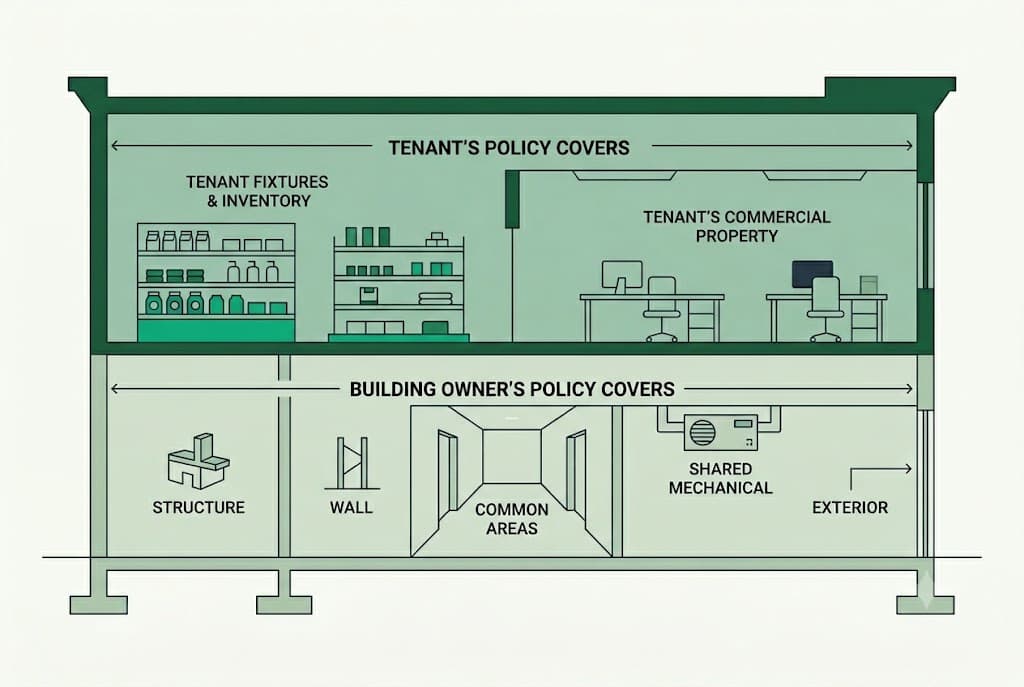
What Your Tenants’ Insurance Does NOT Cover
- ×Your building structure
- ×Your common areas, parking lot, and exterior
- ×Your loss of rental income
- ×Damage caused by your building systems to their property
What Your Tenants’ Insurance DOES Cover
- ✓Their business personal property (inventory, equipment, furniture)
- ✓Their business liability (customers injured inside their space)
- ✓Their loss of business income if they can’t operate
The Critical Gap
If a pipe bursts in your tenant's ceiling and destroys their inventory, whose insurance pays? The answer surprises most landlords: both will initially deny. The tenant's insurer says “the landlord's building caused the damage.” The landlord's insurer says “the tenant is responsible for their own property.” This is why lease language matters as much as policy language — and why most commercial leases have insurance gaps that nobody catches until there's a claim.
Lease Insurance Requirements Every Commercial Landlord Needs
1. Tenant GL with Specific Minimum Limits
Require tenants to carry GL with at least $1M/$2M limits. Higher-risk tenants (restaurants, auto shops) should carry $2M/$4M.
2. Landlord Named as Additional Insured
Your entity must be listed as an additional insured on the tenant’s GL policy. This extends their coverage to you for claims arising from their operations.
3. Primary and Non-Contributory Language
The tenant’s policy must pay first on any claim. Your policy should never contribute to claims arising from the tenant’s operations.
4. Waiver of Subrogation
The tenant’s insurer agrees not to pursue you for damages it has paid. Without this, the tenant’s insurer can sue you after paying a claim.
5. COI Before Occupancy and at Every Renewal
Require a Certificate of Insurance before the tenant moves in and updated certificates annually. Don’t accept move-in without verified coverage.
6. 30-Day Notice of Policy Cancellation
The tenant’s carrier must notify you if the policy is cancelled or non-renewed. Without this, you won’t know when a tenant loses coverage.
When was the last time someone actually verified your tenants' against these requirements? Most commercial landlords find out about the gap only when there's a claim.
For a deeper understanding of how works alongside tenant policies, read our guide on Commercial Landlord Insurance: What Owner Policies Skip.
Section summary
The 8 Mistakes Commercial Landlords Make With Insurance
These are the coverage gaps and process failures we see repeatedly across hundreds of commercial landlord policy reviews. Each one is preventable. Each one has cost a building owner real money.
📊 Does your policy know the difference between a $200K tenant and a $5M tenant?
Not all tenants create equal risk. A medical office generating $5 million in revenue creates different liability exposure than a small accounting firm generating $200,000. A restaurant tenant with deep fryers and grease hoods creates different property risk than a retail boutique. Yet most commercial landlord policies treat all tenants the same — the premium and coverage don’t reflect the actual risk profile of your tenant mix. High-risk tenants like restaurants, auto repair shops, and manufacturing businesses should trigger higher coverage limits and specific endorsements. If your policy doesn’t account for tenant type, it’s probably not covering the actual risk.
How to fix this: Provide your agent with a tenant roster that includes business type, revenue (if known), and lease terms for each tenant. Ask them to review whether your GL limits, property coverage, and endorsements reflect the actual risk created by each tenant’s operations.
A medical suite, a deep-fryer restaurant, and a quiet accounting office don’t create the same property or liability exposure — yet many programs rate and cover them as if they did. The question worth asking before your next renewal: does your current policy reflect the actual risk each tenant brings to the building, or is it carrying the same limits and endorsements it would for any tenant in any space?
🏢 When was the last time you read what your tenants’ insurance actually covers?
Most landlords require tenants to provide a Certificate of Insurance at lease signing and never check it again. But a COI is a snapshot in time — it proves the tenant had insurance on the day it was issued. It doesn’t prove they still have it. Policies get cancelled for non-payment, limits get reduced at renewal, and endorsements get dropped. If your tenant’s policy lapsed three months ago and their customer slips inside the space, the claim comes to your GL policy. Your premiums go up. Your tenant’s lapsed insurance becomes your problem.
How to fix this: Implement an annual COI verification process. Require every tenant to provide an updated COI at least 30 days before their policy renewal date. Verify that limits, additional insured status, and waiver of subrogation are current. Your property manager should track this for every tenant.
Across the multi-tenant buildings our team reviews, a significant share carry tenant COIs that don’t match the underlying lease requirements — wrong additional-insured language, missing waiver of subrogation, expired certificates, or coverage limits below what the lease demands. The question your office should be able to answer: when did your team last audit your tenants’ COIs against the leases — not at lease signing, but as the policies have renewed since?
🚪 What happens when a unit sits empty for 60 days?
This is the gap that catches more commercial landlords than any other. Standard commercial property policies include a vacancy clause that eliminates coverage for water damage, theft, vandalism, and sprinkler leakage after 60 consecutive days of vacancy. The policy doesn’t warn you when you cross the 60-day mark. There’s no notification. You simply lose coverage — and you won’t know until you file a claim and it’s denied. In multi-tenant buildings, the clause typically applies per-unit, not per-building. So if one of four units is vacant for 90 days, the vacancy exclusion applies only to that unit.
How to fix this: Add a vacancy permit or vacancy endorsement to your policy before any unit crosses the 60-day mark. Notify your carrier immediately when a tenant moves out. Track vacancy duration for every unit. The cost of the endorsement is a fraction of a denied claim.
Vacancy provisions in most commercial property policies reduce or eliminate coverage when units sit unoccupied beyond a defined period — typically 60 days. The question worth asking before any tenant turnover: does your policy carry a vacancy endorsement that maintains coverage during the gap between leases, or does the standard vacancy clause expose the building to denial of a covered loss claim?
📋 Does your tenants’ insurance actually meet the requirements in your lease?
Your lease likely specifies that tenants must carry GL with $1M/$2M limits, name you as additional insured, include waiver of subrogation, and maintain primary/non-contributory language. But have you ever actually verified that the tenant’s policy matches these requirements? A COI shows coverage exists — it doesn’t prove the endorsements are in place. Many tenants buy the cheapest policy available and assume it’s compliant. It’s often not. And when a claim hits and the tenant’s policy doesn’t match what the lease requires, the landlord’s policy becomes the backstop.
How to fix this: Don’t just collect COIs — read them. Verify that the certificate holder name matches your entity exactly. Confirm additional insured and waiver of subrogation endorsements are listed. Check that limits meet or exceed your lease requirements. If anything is missing, require correction before the tenant takes occupancy.
An injury or property-damage claim involving an uninsured tenant contractor on common areas typically defaults to the building’s GL policy. The claims history that follows can drive renewal premium increases for years. The question worth asking: does your lease require tenants to enforce vendor COI compliance — and does your property manager verify that enforcement before any tenant contractor steps on building common areas?
💸 If your biggest tenant leaves tomorrow, does your policy replace the rent?
Loss of rents coverage protects your rental income when a covered loss (fire, storm, etc.) makes the building uninhabitable. But it only covers income lost due to insured perils — it doesn’t cover a tenant simply leaving. That said, most landlords don’t carry enough loss of rents coverage even for covered losses. If a fire requires more than a year of reconstruction, the loss of rents limit has to cover every month the building sits offline. Many landlords carry only six months — leaving a gap that means paying the mortgage out of pocket while the building is being rebuilt.
How to fix this: Calculate 12–18 months of gross rental income and set your loss of rents limit accordingly. Review this annually as rents increase. If you have a building under renovation or have recently signed higher-rent leases, update your coverage immediately.
Loss-of-rents limits across most multi-tenant buildings haven’t been re-rated against current rent roll since the original underwriting. Rents rise; the limit doesn’t. The question worth asking: if a fire took the building offline tomorrow, would your loss-of-rents limit cover 12-18 months of current rent — or 12-18 months of rent from three or four years ago?
🔧 Who pays when the HVAC or elevator fails?
Standard commercial property policies cover damage from fire, wind, hail, and other named perils. They do not cover mechanical or electrical breakdown of building systems. If your commercial HVAC unit fails, your elevator motor burns out, or your boiler cracks, the repair bill comes out of your pocket unless you have equipment breakdown coverage (sometimes called boiler and machinery). For commercial buildings with aging systems, a single HVAC failure or elevator motor burnout can run well into five figures. These are maintenance realities that happen every year.
How to fix this: Add equipment breakdown coverage to your commercial property policy. It covers mechanical and electrical failure of building systems, and the annual cost depends on the number and age of systems. Compare that to the cost of a single HVAC replacement.
A meaningful share of commercial building owners don’t carry equipment breakdown coverage on their property programs. When a chiller fails mid-summer or a boiler ruptures mid-winter and the standard property policy excludes the loss as wear-and-tear or mechanical breakdown, the repair costs and the loss-of-rents from tenant impact land on the building owner. The question worth asking: does your current property policy carry equipment breakdown — or does it exclude the systems most likely to fail?
💵 Is your building insured for replacement cost or purchase price?
This is one of the most expensive errors in commercial landlord insurance. Many building owners set their policy limits based on what they paid for the property, what the bank appraised it for, or what the tax assessor values it at. None of these reflect what it would actually cost to rebuild the building today. Construction costs have risen materially across many markets in recent years. A building purchased several years ago can cost substantially more to rebuild today. If your policy covers the old purchase price and the building is destroyed, you’re short the difference — and you’re still paying the mortgage on a building that no longer exists.
How to fix this: Get an independent replacement cost appraisal every 3–5 years. Don’t rely on your carrier’s estimate, your tax assessment, or your purchase price. Apply an inflation guard endorsement (3–5% annually) between appraisals to keep pace with construction cost increases.
Buildings insured at purchase price or original loan amount carry the full rebuild gap as owner exposure. Construction costs across most commercial markets have risen materially since the building was first underwritten. The question worth asking at every renewal: is your property limit set against current rebuild cost, or against an appraisal from before the cost curve moved?
⚠ Have you ever had a professional review every lease against your insurance policy?
Your leases contain insurance obligations — both what you’re required to carry and what your tenants are required to carry. Your insurance policy contains its own terms, conditions, and exclusions. These two documents need to align. If your lease promises tenants that you’ll carry $2M in GL but your policy only covers $1M, you’re in breach. If your lease requires tenants to carry additional insured endorsements but your property manager never verifies, you’re exposed. Most commercial landlords have never had a professional compare their leases to their insurance side by side.
How to fix this: Before your next renewal, give your insurance agent copies of every active lease. Ask them to identify any gap between what the lease requires and what the policy provides. This comparison takes about an hour per property and prevents six-figure problems.
Boards and property managers who actively review renewal proposals line-by-line against the expiring declarations consistently find changes the carrier made without highlighting them: reduced limits, added exclusions, increased deductibles, removed endorsements. The question worth asking: when was the last time your office did this review at renewal — instead of relying on the broker’s auto-roll?
Section summary
Premium Drivers
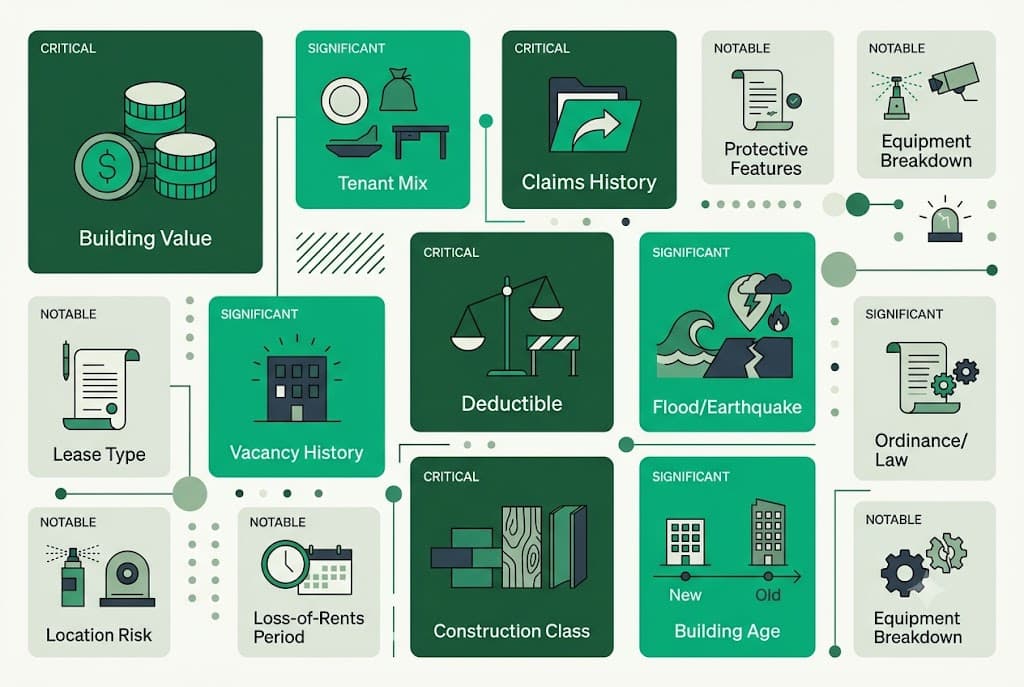
What Drives Your Commercial Landlord Insurance Premium
The question worth asking before every renewal isn't what your commercial landlord premium is. It's which of these factors is moving your specific quote — and which ones your current broker isn't even checking against your actual rent roll, tenant mix, and lease obligations.
| Rating Factor | Impact on Premium | |
|---|---|---|
| Building total insured value (TIV) | CriticalLargest single property premium driver — scales with the limit | |
| Construction class (frame vs masonry vs fire-resistive) | SignificantFrame rates higher than masonry or fire-resistive | |
| Building age + condition (roof, HVAC, electrical, plumbing) | SignificantOlder systems raise the property rate | |
| Tenant occupancy mix (retail, office, industrial, restaurant) | CriticalRestaurant and medical tenants raise GL and property exposure | |
| Claims history (last 5 years) | CriticalRecent losses drive renewal pricing up | |
| Geographic location (coastal, wildfire, hail, hurricane zones) | CriticalAdds catastrophe load where the building sits in an exposed zone | |
| Number of tenants + lease type mix (NNN, gross, percentage) | SignificantMore tenants and gross leases shift more exposure to the owner | |
| Loss-of-rents coverage period (12 / 18 / 24 months) | SignificantLonger indemnity periods raise the business-income premium | |
| Vacancy history + current vacancy rate | SignificantCurrent and recent vacancy raises rate and can trigger clauses | |
| Protective features (sprinklers, alarms, fire suppression) | NotableSprinklers, alarms, and suppression earn credits | |
| Deductible selection | NotableHigher deductibles lower premium, raise owner retention | |
| Flood + earthquake exposure | CriticalSeparate policies add to the total program where exposed | |
| Ordinance or law coverage limit | NotableOlder buildings carry more code-upgrade exposure | |
| Equipment breakdown inclusion | NotableInclusion adds modest premium, closes a common exclusion |
A complete commercial landlord insurance program typically includes these lines:
| Coverage | Purpose | Typical Limits | |
|---|---|---|---|
| Commercial Property (Lessor’s Risk form) | Building structure, common areas, owner improvements | 100% replacement cost | |
| General Liability | Third-party injuries on common areas | $1M per occurrence / $2M aggregate | |
| Loss of Rents / Business Income | Lost rental income during covered repairs | Annual rent roll × 12–24 months | |
| Umbrella / Excess Liability | Additional layer above GL | Building value plus one year’s rent roll | |
| Equipment Breakdown | HVAC, boilers, elevators, electrical panels | Aligned to TIV | |
| Inland Marine / Signs | Building signage, outdoor fixtures, portable equipment | Scheduled item value | |
| Flood / Earthquake (where applicable) | Perils excluded from the standard property form | Varies by zone and TIV |
Commercial landlord premiums move on building value, tenant mix, claims history, lease type structure, and amenity exposure — building-specific operational details no generic quote can know. The program worth binding is the one matched to your leases, your rent roll, and your current replacement cost.
Section summary
Before the next renewal
Most commercial property programs are renewed against last year's declarations — without anyone reading the leases.
We pull your leases, match coverage requirements line-by-line against the current policy and the tenants' COIs, and surface the gaps before the next renewal — not after a tenant claim, a vacancy denial, or a lender certificate request.
State-Specific Considerations
Commercial landlord insurance requirements and pricing vary significantly by state. Local building codes, natural disaster exposure, and tenant law all affect what coverage you need and what it costs. Here are a few notable examples:
California
Strict lease law requirements and high property values drive higher premiums. Earthquake coverage is often necessary but excluded from standard policies — it requires a separate policy through the California Earthquake Authority or a surplus lines carrier. Wildfire exposure in expanding urban-wildland interface zones adds further complexity. California also has some of the strongest tenant protection laws in the country, making lease insurance compliance critical. California commercial landlord insurance
Texas
Generally landlord-friendly state laws, but wind and hail exposure in eastern and coastal regions significantly affects property insurance pricing. The growing commercial real estate market in Dallas, Houston, Austin, and San Antonio means more building owners entering the market who need guidance on building owner coverage. Named storm deductibles along the coast can be 2–5% of the building value. Texas commercial landlord insurance
Colorado
Mountain region risks including hail, wildfire, and snow load affect commercial property pricing. The Denver metro commercial boom has increased property values and replacement costs significantly, making accurate valuations critical. Colorado's construction defect laws also affect landlords who are renovating or building new commercial properties. Colorado commercial landlord insurance
New Jersey
High property values, strict building codes, and hurricane exposure on coastal properties create unique insurance challenges. Older commercial buildings in urban areas often require specialized coverage for aging infrastructure. The state's dense commercial real estate market means vacancy rates and tenant quality are critical factors in coverage decisions. New Jersey commercial landlord insurance
We serve commercial landlords across 29 states, and our agents understand the specific building codes, natural disaster exposure, and lease law requirements in each one. See all 29 states we serve to find state-specific information for your property — including Illinois commercial landlord insurance.
Frequently Asked Questions
How much landlord insurance do I actually need?
What’s the difference between landlord insurance and commercial property insurance?
Does my tenant’s insurance protect my building?
What happens if a unit is vacant for more than 60 days?
How do I know if my loss of rents coverage is enough?
Do I need separate policies for each property I own?
What’s the difference between replacement cost and actual cash value?
Who’s responsible when a tenant’s equipment damages my building?
Why do my tenants need to name me as additional insured?
What documents do I need to get a commercial landlord insurance quote?
We Review Your Leases Before You Bind

Most insurance agents quote commercial landlords based on a property questionnaire: square footage, construction type, age, done. They never see the leases that dictate your actual insurance obligations. We do it differently. Before we issue a proposal, we read your leases. We cross-check your tenants' COIs against your lease requirements. We identify gaps between what your lease says you must carry and what your policy actually provides.
Then we present our findings to you on a video call, in plain English. No jargon, no pressure — just a clear explanation of where your building owner coverage stands, where the gaps are between your leases and your policy, and what your options are. This is what we call a consultative review, and it's included at no cost for every commercial landlord client.
It's also why building owners who work with us rarely discover coverage surprises at claims time. When we say your policy matches your lease obligations, it does — because we've read both.
Watch Patrick Walk Through a Real Commercial Landlord Policy Review
See exactly what a lease-to-policy comparison looks like — from lease analysis to tenant COI verification to coverage recommendation — in under 10 minutes.
This consultative approach is the same process we bring to contractor insurance for tenant buildouts and property improvements and HOA insurance for mixed-use properties with residential components. For buildings with food service tenants, we also handle restaurant insurance for food service tenants in commercial buildings.
Need financing for a building acquisition or renovation? Commercial real estate financing and building owner loans may be an option worth exploring.
Bottom line

Ready to Take the Next Step?
Whether you're reviewing your current building owner coverage, adding a property to your portfolio, or filling a vacancy gap, these tools will help you make informed decisions.
Ready for a policy review? Get Building Owner Coverage →