
HOA Insurance Guide 2026: What Your CC&Rs Demand
Everything HOA boards need before the next renewal — master policies, D&O, fidelity bonds, and the gaps that cost mid-large associations six figures. Written by Bobby Friel and the Direct Insurance Services team.

Bobby Friel
Partner, Direct Insurance Services
Bobby Explains
Watch: HOA Insurance Explained
What every board member needs to know about protecting your association.
For Operators
Who This Guide Is For
- HOA board members — volunteer or professional — at mid-large board-managed associations responsible for selecting and renewing the association’s insurance program
- HOA property managers who oversee insurance compliance and vendor requirements for managed communities
- HOA treasurers and presidents reviewing annual insurance renewals at associations with real reserve balances and real governance complexity — and wondering whether the association is actually protected
What brought you here?
Most HOA boards don’t pick up a guide on community association insurance because they’re curious. They picked it up because something just happened — a renewal proposal came in 19% above last year and the treasurer flagged it for review, a homeowner’s attorney sent a letter alleging breach of fiduciary duty over an assessment dispute, the reserve study just landed and the replacement-cost number is millions above the master policy’s current limits, or a vendor incident on common area surfaced a COI gap nobody had reviewed in three years.
~373K
U.S. community associations as of year-end 2025
CAI Foundation for Community Association Research, 2025 Fact Book
~75.5M
U.S. residents living in community associations
CAI Foundation for Community Association Research, 2025 Fact Book
Case Study: 240-Unit Master Association — D&O Gap Discovered at Renewal

HOA Scenario
OPERATOR SCENARIO
Scenario
Mid-large board-managed master association — 240 units, professional management company on a multi-year contract, reserve balance in the low seven figures. Renewal proposal arrives 19% above the expiring year and the board treasurer flags it for review before sign-off.
The board’s current program: master property, general liability, fidelity bond, . is absent. The management agreement assigns “all insurance procurement and renewal review” to the property manager, who has been auto-binding renewals on the same package for three cycles.
A current homeowner has filed a small-claims petition over an assessment increase ratification process. The board’s attorney has already opened a file. The renewal proposal is silent on D&O — the broker assumed the prior placement was a deliberate choice.
What we did
Pulled the CC&Rs, bylaws, and the last three years of board meeting minutes. Confirmed the CC&Rs require D&O coverage with limits not less than association annual revenue plus operating reserves. Matched the management agreement insurance schedule against the prior policy declarations and identified D&O as the only missing line. Sourced a D&O placement with retroactive coverage to the most recent board election, prior-acts coverage, and defense costs outside the limit. Re-priced the master property at current replacement cost using the most recent reserve-study replacement-value table, surfaced a 14% property under-insurance gap, and adjusted the limit before renewal bind.
🎯 The Outcome
D&O bound with retroactive coverage in place before the small-claims hearing date. Master property limit aligned to the current reserve-study replacement valuation. The board now has a documented annual review process tied to the CC&R insurance schedule — and the proposal the board actually approved was a wholesale rebuild, not a 19% increase on the same package the previous broker had been auto-rolling.
The Six Lines Every HOA Board Carries
Most associations carry one or two of these. Fully protected associations carry all six. Each card below names the line, the limit framing, and the question that line answers when something goes wrong.
01
🏢Master Property Policy
Covers buildings, common areas, shared mechanical, structures up to the policy boundary defined by your CC&Rs (Bare Walls / Single Entity / All-In). Limits: 100% of current replacement cost — not market value, not assessed value. The question this answers when something goes wrong: when a covered loss exceeds your limit, where does the gap come from — reserves, special assessment, or board liability for under-insurance?
02
⚖️Directors & Officers (D&O)
Covers legal defense + settlements when board members are sued in official capacity — mismanagement, assessment disputes, breach of fiduciary duty, wrongful CC&R enforcement. Limits: $1M minimum under 100 units; $2M–$5M for larger or contentious-governance associations. The question this answers: when a homeowner’s attorney sends a demand letter, do your board members’ personal assets sit behind the policy — or in front of it?
03
🛡️General Liability
Covers third-party bodily injury and property damage on common areas — slip-and-falls, pool-deck injuries, playground accidents. Limits: $1M per occurrence / $2M aggregate minimum; higher for pools, gyms, or playgrounds. The question this answers: when a third party is injured on common area and the claim exceeds primary GL, what’s the layer above — umbrella, association assets, or both?
04
👷Workers Compensation
Covers injuries to HOA employees — maintenance crew, on-site management staff, office personnel, paid security. Pays medical bills, lost wages, and rehabilitation costs. Limits: state statutory minimums — governed by state workers compensation law, not by the policy. The question this answers: when an HOA maintenance worker is injured on common area tomorrow, does workers comp respond — or does general liability get a claim it isn’t designed to cover, with personal exposure for the board if the policy wasn’t in place?
05
💰Fidelity Bond / Crime Coverage
Covers theft of association funds by anyone with access — board members, property managers, bookkeepers, vendors. Limits: three months of total assessments plus the full reserve balance. The question this answers: if a manager or board treasurer redirected reserves tomorrow, how much would the bond actually replace — and is that bond amount current to today’s reserves, or to the balance from before the last assessment increase?
06
☂️Umbrella / Excess Liability
Adds limits above GL and D&O primary policies, layered over the entire program. Limits: total assets plus one year’s operating budget at minimum. The question this answers: when primary limits exhaust on a catastrophic claim, does the umbrella respond — or does the gap become a special assessment?
Section summary
Master Policy Types Explained
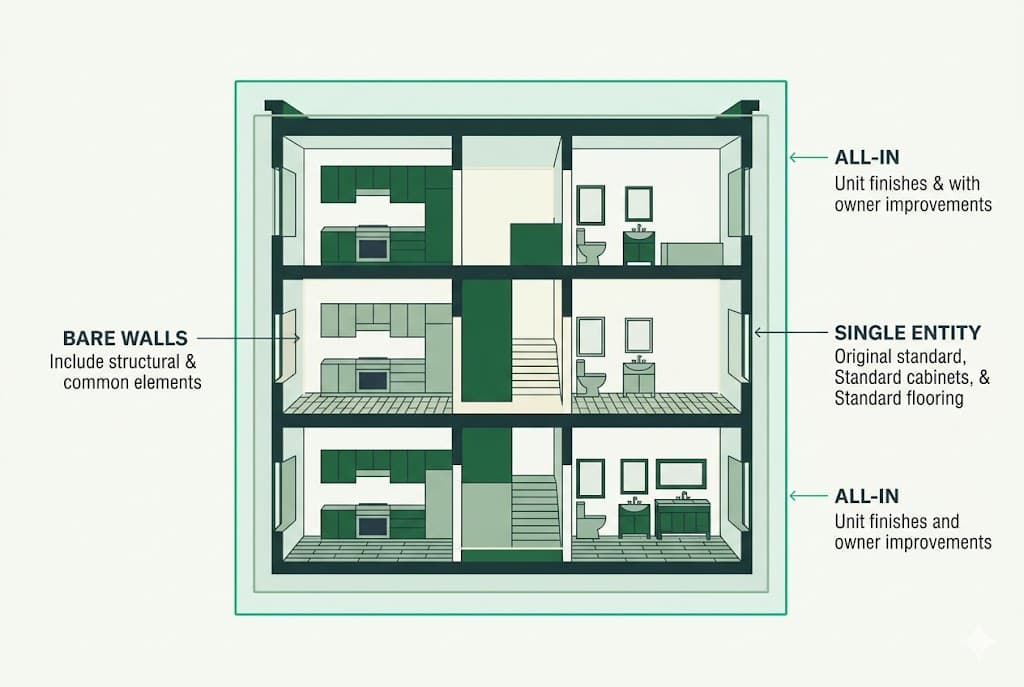
This is the section that confuses most boards — and the confusion costs homeowners thousands of dollars after every major claim. Your falls into one of three categories, and the type you have determines who pays for what when there's a loss. For a deeper comparison, see our article on HOA master policy vs unit owner policy.
| Master Policy Type | Association Covers | Owner Responsible For |
|---|---|---|
| Bare Walls (Walls-In) | Structure to unfinished drywall, common areas, shared systems | All interior finishes, fixtures, appliances, flooring, cabinets, and improvements |
| Single Entity (Original Spec) | Everything as originally built, including standard finishes and fixtures | Improvements and betterments only (upgrades beyond original construction) |
| All-In | Everything including unit improvements and upgrades | Personal property and personal liability only |
Do you know which of these three policy types your association currently has? More importantly — do your homeowners know? Because the answer determines who pays when there's a pipe burst in a unit.
🧱
Most common in older condominiums. The association insures the building shell. Owners need comprehensive HO-6 policies because they're responsible for everything from the drywall inward — flooring, cabinets, appliances, plumbing fixtures, and all finishes.
🏗️
The middle ground. Association covers the unit as the developer originally built it. Owners only insure their upgrades — granite countertops that replaced laminate, hardwood floors that replaced carpet, custom cabinetry. This is the most common type for newer construction.
🏠
The most comprehensive (and most expensive). Association covers everything, including owner improvements. Owners still need HO-6 for personal belongings, personal liability, and loss of use. Less common due to higher premiums, but simplifies claim responsibility.
Section summary
“Boards that don't have coverage surprises aren't the ones whose carriers said yes fastest — they're the ones whose agent read the CC&Rs first.”
— Bobby Friel · Partner, Direct Insurance Services
The 8 Mistakes HOA Boards Make With Insurance
Across the HOA policies our team reviews, the same handful of gaps surface repeatedly. Each one is preventable. Each one has cost real associations real money — typically discovered at claim time, when the board is already explaining the gap to homeowners.
💰 Are you sure your master policy limits match your replacement cost — not your market value?
This is the single most expensive mistake HOA boards make. Market value includes land, location, and demand. Replacement cost is what it would cost to rebuild the physical structure at today’s construction prices. Many associations set their policy limits to their property’s assessed or market value, which can fall meaningfully below actual replacement cost. After a total loss, the association is left with a gap that becomes a special assessment, a reserve drawdown, or a fiduciary exposure question at the next board meeting.
How to fix this: Get an independent replacement cost appraisal every 3–5 years. Don’t rely on your carrier’s estimate or your tax assessment. Apply an inflation guard endorsement between appraisals.
If a hailstorm hit your roof tomorrow and the contractor’s estimate came back materially above your master property limit, where does the gap come from — reserves, special assessment, or board exposure for under-insurance?
📄 When was the last time your board compared the master policy against your CC&Rs?
Your CC&Rs are a legal contract between the association and its members. They specify insurance requirements — coverage types, minimum limits, loss assessment provisions. If your actual policy doesn’t match what the CC&Rs require, the board is in breach of its fiduciary duty. This breach is discoverable by any homeowner, any attorney, and any court. It doesn’t take a loss to trigger the liability — just a motivated homeowner. Across the HOAs our team reviews, a significant share carry at least one material gap between what the CC&Rs require and what the policy actually provides.
How to fix this: Pull your CC&Rs and your current policy declarations. Compare them line by line at every renewal. If you’re not sure what to look for, have your insurance agent do the comparison.
When was the last time your board could say, with documentation, that the policy matches the CC&Rs line-by-line — not "we assume so" but with a written comparison?
⚖ Does your board carry D&O coverage — or are members personally exposed?
Board members are volunteers making financial decisions on behalf of the community. Without D&O coverage, they’re personally liable for lawsuits alleging mismanagement, discrimination, failure to maintain, wrongful assessment, or breach of fiduciary duty. Litigation against HOA boards has been trending up across most markets. The question worth asking isn’t whether D&O claim frequency is rising in the aggregate — it’s whether your specific board’s exposure has been re-evaluated since the last contentious vote, the last assessment increase, or the last governance change.
How to fix this: Add D&O coverage if you don’t have it. Ensure it includes prior acts coverage and covers defense costs outside the limit (so legal fees don’t eat into your coverage amount).
If a homeowner’s attorney sent a demand letter tomorrow, do your board members’ personal assets sit behind the policy — or in front of it?
🔒 Is your fidelity bond large enough to cover your reserves and three months of assessments?
Fidelity bonds protect against theft of association funds by anyone with access — board members, property managers, bookkeepers, vendors. The minimum recommended amount is three months of assessments plus the full reserve balance. Many associations carry a bond sized to a prior reserve balance — the bond hasn’t been re-evaluated since the last assessment increase or the last reserve contribution cycle. Your fidelity bond was sized to the policy your prior broker quoted. Your reserve balance has grown since then.
How to fix this: Calculate three months of total assessments plus your current reserve balance. That’s your minimum fidelity bond amount. Update this annually as reserves grow.
Could your current bond actually replace your reserves as they sit today — or only the reserves as they were before the last assessment increase?
📋 Are you requiring Certificates of Insurance from every vendor and contractor?
When a contractor or vendor works on HOA property without providing proof of insurance — and specifically without naming the HOA as an additional insured — the association’s policy becomes the default. If the contractor’s employee falls off a ladder, gets electrocuted, or causes property damage, your general liability policy responds. An injury or property-damage claim involving an uninsured contractor on common areas typically defaults to the association’s GL policy. The claims history that follows can drive renewal premium increases for years.
How to fix this: Create a written COI requirement for all vendors. Require general liability, workers’ compensation, and additional insured status before any work begins. Your property manager should enforce this for every job.
Does your property manager actually enforce a COI requirement before any contractor steps on common area — or does it happen sometimes?
☂ Does your association have umbrella coverage — and is the limit adequate?
General liability policies typically max out at $1–$2 million per occurrence. A serious injury at the pool, a playground accident, or a wrongful death claim in a parking garage can easily exceed that. Umbrella coverage sits on top of your GL and auto policies, providing an additional $1–$10 million in protection. Umbrella coverage adds limits at a meaningfully small premium relative to the excess exposure it covers. The question worth asking isn’t what it costs — it’s whether your total liability stack equals at least your association’s total assets plus one year’s operating budget.
How to fix this: Your umbrella limit should equal at least your total assets plus one year’s operating budget. Associations with pools, gyms, or playgrounds should add an extra $1–2 million.
If primary GL exhausted on a catastrophic claim tomorrow, what layer sits above — and does it equal your association’s total assets plus one year’s operating budget?
📅 Are you reviewing your policy at renewal — or just auto-renewing?
Many boards treat insurance renewal as a checkbox: the renewal comes in, the board treasurer signs off, and the premium gets paid. Boards that actively review renewal proposals — line by line against the expiring declarations — consistently find changes the carrier made without highlighting them: reduced limits, added exclusions, increased deductibles, removed endorsements. Carriers make these adjustments every year, and they’re not required to highlight them for you.
How to fix this: Set a calendar reminder 90 days before renewal. Request your current policy and renewal proposal. Compare them line by line or have your agent prepare a renewal comparison showing every change.
When was the last time your board did a line-by-line comparison at renewal — not just the premium number, but limits, exclusions, endorsements, and deductibles?
📣 Has your board communicated homeowner insurance responsibilities to unit owners?
Your master policy has limits. Regardless of whether you carry Bare Walls, Single Entity, or All-In coverage, unit owners need their own HO-6 policies for personal property, personal liability, loss of use, and often interior improvements. When there’s a loss and a homeowner discovers their master policy doesn’t cover their $40,000 kitchen remodel — because it was an improvement beyond original construction — they blame the board. And sometimes they sue. A meaningful share of condo and townhome owners do not carry an HO-6 policy of their own.
How to fix this: Send an annual letter to all homeowners explaining what the master policy covers and doesn’t cover, and recommend minimum HO-6 limits. Include this in your welcome packet for new owners.
Has your board sent a written communication this year reminding homeowners what the master policy does and doesn’t cover — and recommending minimum HO-6 limits?
Section summary
Premium Drivers
What Drives Your HOA Insurance Premium
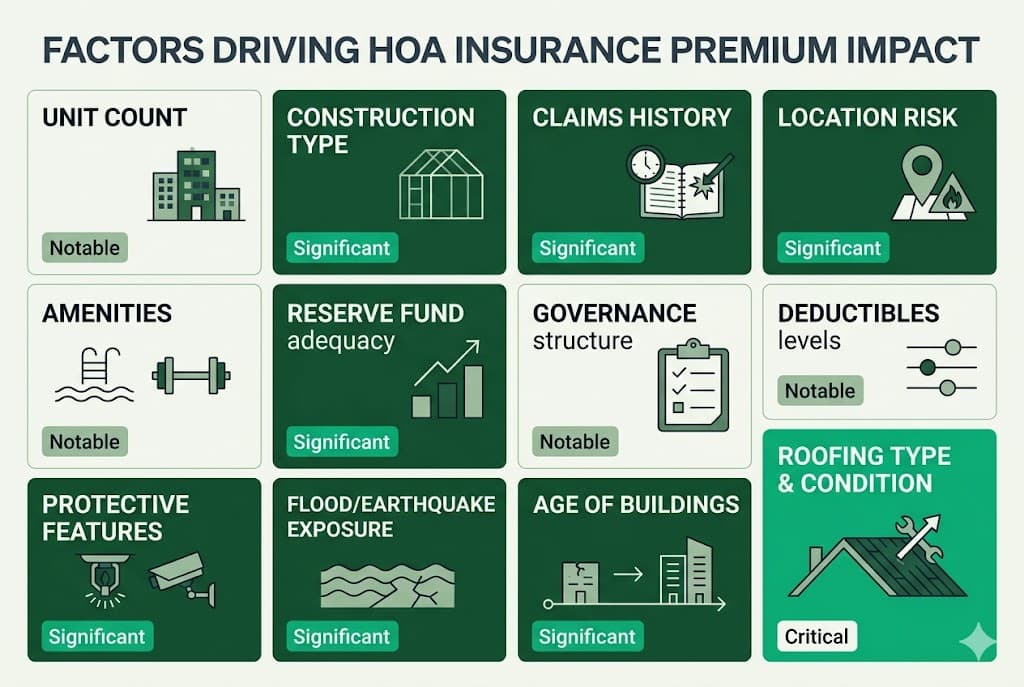
The question your board should be able to answer at every renewal isn’t what the premium is. It’s which of these factors is moving your specific quote — and which ones your current broker isn’t even checking.
| Rating Factor | Impact on Premium | |
|---|---|---|
| Number of units + total insured value | CriticalThe largest single property premium driver — scales linearly with insured value. | |
| Construction type (frame vs masonry vs fire-resistive) | SignificantFire-resistive and masonry materially reduce property rate vs frame. | |
| Building age + condition (roof, plumbing, electrical) | SignificantAged systems and end-of-life roofs drive carrier scrutiny and rate. | |
| Claims history (last 5 years) | CriticalThe most actionable factor at renewal — clean loss runs win pricing. | |
| Geographic location (coastal, wildfire, hail zones) | CriticalCAT-exposed regions carry markedly different property terms. | |
| Amenities (pool, gym, playground, clubhouse) | SignificantEach amenity adds GL exposure and informs umbrella sizing. | |
| Association budget + reserve fund size | SignificantDrives fidelity bond limit sizing and informs D&O premium. | |
| Board governance history (lawsuits, disputes) | SignificantD&O carriers price contentious governance materially higher. | |
| Condo vs townhome vs single-family HOA | SignificantProperty scope differs sharply across community types. | |
| Deductible selection | NotableHigher deductibles reduce premium meaningfully on property line. | |
| Protective features (sprinklers, alarms, gated entry) | NotableDocumented protective features earn credits on property + GL. | |
| Flood + earthquake exposure | CriticalSeparate policies; CAT exposure adds layers beyond the base program. |
A complete HOA insurance program typically includes these policy lines:
| Coverage | Purpose | Typical Limits | |
|---|---|---|---|
| Master Property | Common elements, building structure, shared systems. | 100% replacement cost | |
| General Liability | Third-party injuries on common areas. | $1M occurrence / $2M aggregate | |
| Directors & Officers (D&O) | Board decisions, governance disputes, wrongful acts. | $1M–$5M based on unit count + exposure | |
| Fidelity Bond / Crime | Theft of association funds by board or management. | Three months assessments + full reserves | |
| Workers Compensation | Injuries to HOA employees (maintenance, office). | State statutory minimums | |
| Umbrella / Excess Liability | Additional layer above GL and D&O primary. | Total assets + one year operating budget |
Every association is different. Rather than guessing from a generic table, the right next step is a governing-documents review against your current policy.
For a deeper breakdown of what drives HOA premium in 2026, read our complete guide to HOA insurance costs in 2026.
Section summary
Before the next renewal
Most HOA master policies are renewed against last year's declarations — without anyone reading the CC&Rs.
We pull your governing documents, match coverage requirements line-by-line against the current policy, and surface the gaps before the next board meeting — not after a homeowner files.
State-Specific Considerations
HOA insurance requirements vary significantly by state. Some states mandate specific coverage types and minimum limits, while others leave it entirely to the association's governing documents. Here are a few notable examples:
California (Davis-Stirling Act)
California's (Civil Code §4000+) sets insurance requirements at §5800-§5810. The statute mandates D&O minimums by unit count ($500K minimum for associations of 100 or fewer units; $1M minimum for associations of more than 100 units), general liability minimums ($2M for smaller associations, $3M for larger), and a equal to the reserve balance plus three months of assessments. The board must disclose insurance information in the annual budget report and notify members when coverage changes, lapses, or fails to meet requirements. California HOA insurance requirements
Texas
Texas governs condominium associations under (the Uniform Condominium Act), with insurance specifics at §82.111. Single-family residential lot HOAs are governed by (the Residential Property Owners Protection Act). Texas law generally defers to the association's declaration for specific coverage requirements, but mandates that condominium associations maintain adequate property and liability coverage on common elements. D&O coverage is not state-mandated but is strongly recommended given Texas's litigation-friendly environment. Texas HOA insurance considerations
Colorado (CCIOA)
Colorado's (C.R.S. §38-33.3-101+) governs associations created on or after July 1, 1992. The insurance section at §38-33.3-313 requires property insurance on common elements at replacement cost (less applicable deductibles), commercial general liability covering the board, manager, and employees, and fidelity insurance equal to two months of current assessments plus reserves for associations of 30 or more units where a unit owner, employee, or manager controls association funds. All requirements apply “to the extent reasonably available.” Colorado HOA insurance regulations
We serve HOA associations across 29 states, and our agents understand the specific statutory requirements in each one. See all 29 states we serve to find state-specific information for your association.
Frequently Asked Questions
How much HOA insurance do we actually need?
Does our master policy cover homeowner units?
Do we need separate D&O for each board member?
What happens if our master policy doesn’t meet CC&R requirements?
Who pays when a contractor gets hurt on common areas?
How often should we update our master policy limits?
What’s the difference between fidelity bond and crime coverage?
Does our property manager’s insurance protect the HOA?
How do we know if our umbrella coverage is enough?
What documents does an insurance agent need to quote our HOA?
We Review Your Governing Documents Before You Bind

What Most Insurance Agents Do for HOAs
- ×Quote from a generic questionnaire (unit count, ZIP, claims)
- ×Never ask to see the CC&Rs or bylaws
- ×Treat D&O as optional
- ×Match limits to the prior policy, not to current replacement cost
- ×Find out about coverage gaps when a claim is denied or a homeowner sues
What We Do
- ✓Read your CC&Rs, bylaws, and amendments first
- ✓Match coverage to what the governing documents require, not to the renewal quote
- ✓Confirm D&O, fidelity bond sizing, and umbrella limits before bind
- ✓Surface gaps before the renewal — and before the next board meeting
- ✓Present findings to the board on video, in plain English
Most insurance agents quote HOAs based on a questionnaire. We don't. Before we issue a proposal, we read your CC&Rs, bylaws, and any amendments. We compare what your governing documents require against what your current policy actually provides. We identify every gap, every shortfall, and every area where the board is unknowingly exposed.
Then we present our findings to your board on a video call, in plain English. No jargon, no pressure — just a clear explanation of where you stand and what your options are. This is what we call a consultative review, and it's included at no cost for every HOA client.
It's also why associations we work with don't get caught by coverage surprises — because we read the documents first, not after the claim.
Watch Patrick Walk Through a Real HOA Policy Review
See exactly what a consultative review looks like — from governing document analysis to coverage recommendation — in under 10 minutes.
This consultative approach is the same process we bring to contractor insurance for HOA vendors and maintenance contractors and building owner coverage for HOA-owned rental properties. For mixed-use communities with retail tenants, we also handle restaurant insurance for mixed-use HOA retail tenants.
Need to finance a large special assessment or reserve contribution? HOA reserve financing and special assessment loans may be an option worth exploring.
Bottom line
HOA insurance isn't built from a questionnaire. It's built from your governing documents. The right program is the one matched to what your CC&Rs, bylaws, and management agreement actually require — not the one your last broker copied from last year. The questions worth asking your current broker before the next renewal: when did you last read our CC&Rs, when did you last re-rate our replacement cost, and when did you last verify our D&O limit against current exposure?

Ready to Take the Next Step?
Whether you're reviewing your current coverage or starting from scratch, these tools will help your board make informed decisions.
Want a board-ready proposal? Get Board-Ready Coverage →