The Complete Restaurant Insurance Guide 2026: What Every Operator Must Know Before Renewal
A free, no-email-required guide covering liquor liability, business interruption, equipment breakdown, delivery coverage, and the lease requirements that blindside restaurant operators. Written by Bobby Friel and the Direct Insurance Services team.

Bobby Friel
Partner, Direct Insurance Services
Watch
Restaurant Insurance Explained
The coverages every full-service restaurant, bar, and food-service operation needs.
Who this is for
Who This Guide Is For
- Established operators reviewing their current program before the next renewal
- Multi-location operators managing insurance across multiple addresses
- Bar and tavern owners navigating liquor liability exposure and dram shop laws
- Restaurant owners renewing coverage and wondering if they’re actually protected against the exposures that matter most
What brought you here?
Most established restaurant operators don't pick up a guide on restaurant insurance because they're curious. They picked it up because something just happened — a renewal proposal landed 25% above last year and the GM flagged it before sign-off, a dram shop incident at the bar surfaced a coverage gap nobody had reviewed, a line cook injury sent workers comp claims up sharply and the renewal carrier is non-renewing, or a new location is opening and the existing policy structure doesn't extend cleanly to the second address.
15.7 million
restaurant & foodservice jobs — the second-largest private-sector employer
National Restaurant Association, 2026 State of the Industry
7,610
average annual structure fires in U.S. eating & drinking establishments
National Fire Protection Association (NFPA)
61%
share of those fires involving cooking equipment, the leading cause
National Fire Protection Association (NFPA)
Case Study: Established Full-Service Restaurant — Business Interruption Gap Closed Before a Covered Loss
Restaurant Scenario
OPERATOR SCENARIO
Scenario
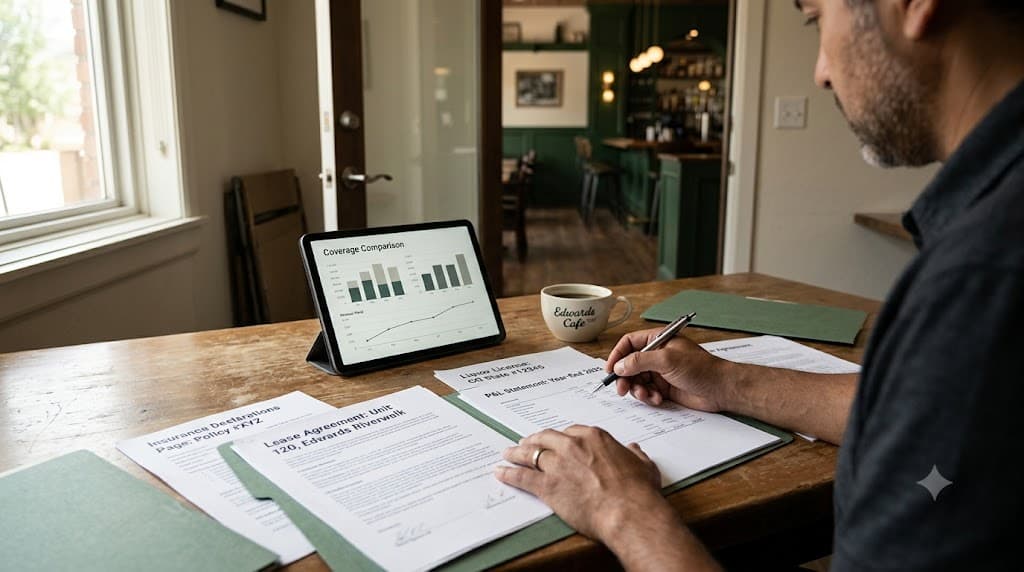
Established full-service restaurant group with full bar service had grown revenue substantially across five years but never revisited the limit set at original opening. The BI limit still reflected the launch-year revenue, not current operations. The current broker's renewal proposal was silent on the revenue growth, silent on the operator's expanded labor footprint, silent on the lease's continuing rent obligations.
The renewal came in 18% above the expiring year. The owner's GM flagged it for review before sign-off. limit unchanged for four years while bar revenue had grown materially. Property limit set against original buildout cost, not against current rebuild cost given construction inflation. Workers comp had drifted from the broker's last review.
What we did
Pulled the current declarations, the liquor license, the operating lease, and the last three years of claims. Recalculated business interruption against current trailing revenue and continuing fixed obligations — rent, equipment financing, key-staff payroll — and flagged the multi-month gap between the legacy limit and a realistic repair-closure timeline for the build-out. Restructured BI to cover 12-18 months of continuing expenses plus net profit. Re-rated liquor liability against current bar revenue. Aligned property valuation to current replacement cost using current construction cost data. Audited the workers comp experience modifier and identified two miscoded claims dragging the xmod higher than current claims experience justified.
🎯 The Outcome
Bound a program matched to current operations rather than auto-rolling the prior structure. Closed the business interruption gap before any covered loss could expose it. The owner approved a rebuilt program at renewal — not a rubber-stamp on a percentage increase to coverage that didn't reflect the restaurant's current revenue, current liquor sales mix, current claims experience, or current build-out value.
The Eight Lines Every Restaurant Operator Carries
Most restaurants carry two or three of these. A fully-built program carries all eight — each one tied to what your current revenue, current liquor sales, current lease obligations, and current claims experience actually demand.
01
🛡️General Liability (GL)
What it covers: Third-party bodily injury and property damage at your locations — slip-and-falls on wet floors, customer injuries, property damage from operations, advertising injury claims. Limits: $1M per occurrence / $2M aggregate minimum. Higher for high-traffic locations or those with active bar service. The question this answers when something goes wrong: When a customer slips on a wet floor and the medical bills + lost wages claim exceeds primary GL, what’s the layer above — umbrella, restaurant assets, or both?
02
🍸Liquor Liability
What it covers: Claims arising from serving alcohol to customers — over-serving leading to third-party injury, dram shop claims, assault and battery on premises tied to intoxicated patrons. Limits: $1M per occurrence minimum for restaurants with active bar service. Higher in states with extensive dram shop laws. The question this answers: When a patron leaves your restaurant intoxicated and causes a third-party injury or property damage that night, does your liquor liability respond — or does your state’s dram shop law leave the restaurant exposed for damages the policy doesn’t cover?
03
🏢Commercial Property + Business Interruption
What it covers: Building (if owned), tenant improvements, equipment, inventory, furniture, and the income/continuing-expenses replacement when a covered loss forces closure. Limits: 100% of replacement cost for property. Business interruption sized to 12-18 months of revenue + continuing fixed obligations (rent, equipment financing, key-staff payroll). The question this answers: When a kitchen fire closes the restaurant for four months tomorrow, does your business interruption limit cover continuing rent, key-staff payroll, and the income loss for the full repair timeline — or does coverage run out months before the doors reopen?
04
👷Workers Compensation
What it covers: Injuries to restaurant employees — kitchen burns, knife injuries, slip-and-falls on wet floors, lifting injuries, repetitive-motion claims. Limits: State statutory minimums. Coverage limits governed by state workers compensation law, not by the policy. The question this answers: When a line cook is burned by a fryer tomorrow, does your workers comp respond cleanly — and is your experience modifier (xmod) being managed before it drives next year’s renewal premium up?
05
🔧Equipment Breakdown
What it covers: HVAC, walk-in coolers, freezers, range hoods, dishwashers, POS systems — the operational equipment standard property policies treat as wear-and-tear exclusions. Plus spoilage coverage for inventory loss when refrigeration fails. Limits: Equipment-specific, typically aligned to total equipment value plus spoilage sub-limit. The question this answers: When a walk-in cooler fails over a holiday weekend and the inventory spoils before the repair tech arrives, does your policy cover the spoiled inventory AND the lost revenue from the closure — or does the standard property policy exclude both?
06
🚚Hired & Non-Owned Auto (HNOA)
What it covers: Liability when employees use personal vehicles for restaurant business — delivery runs, supply pickups, catering off-site, bank deposits. Also covers rental vehicles used for restaurant operations. Limits: $1M combined single limit minimum. Higher for restaurants with active delivery operations or catering. The question this answers: When a delivery driver causes an accident using their personal vehicle on a restaurant run, does your HNOA respond — or does the personal auto carrier deny coverage citing commercial use, leaving the restaurant exposed?
07
☂️Umbrella / Excess Liability
What it covers: Additional limits above GL, liquor liability, and other primary liability policies. Layers over the entire program. Limits: Annual revenue plus one year’s operating expenses at minimum. Higher for restaurants with active bar service or late-night operations. The question this answers: When a catastrophic dram shop claim or customer injury exhausts primary liquor liability or GL limits, does the umbrella respond — or does the gap become a restaurant ownership exposure event?
08
💳Cyber Liability
What it covers: Payment card breach response, customer data compromise, ransomware response, business interruption from cyber incident. POS systems and online ordering platforms are the typical breach vectors. Limits: Restaurant-specific based on payment card volume and customer data held. Typically $250K-$1M for established operators. The question this answers: When your POS system gets compromised and the payment processor’s forensic investigation produces PCI fines plus customer notification costs plus reputation damage, does your cyber liability respond — or does the restaurant absorb the costs out of operating cash?
Section summary
“Restaurant operators who don't have coverage surprises aren't the ones whose carrier said yes fastest — they're the ones whose agent read the liquor license, the lease, and the prior claims first.”
— Bobby Friel · Partner, Direct Insurance Services
What Most Insurance Agents Do for Restaurants
- ×Quote from a generic questionnaire (revenue, ZIP, claims)
- ×Never ask to see the liquor license or the lease
- ×Match limits to the prior policy, not to current revenue, current bar service, or current claims experience
- ×Treat business interruption as boilerplate, not a coverage period decision tied to realistic closure timeline
- ×Find out about coverage gaps when a dram shop claim or kitchen fire hits
What We Do
- ✓Read your liquor license, lease, and prior declarations first
- ✓Match coverage to what your current revenue, liquor sales mix, and lease obligations require
- ✓Re-price property to current replacement cost using current construction cost data
- ✓Size business interruption to current revenue + realistic repair timeline for your build-out
- ✓Confirm liquor liability, workers comp xmod, equipment breakdown, and cyber coverage before bind
- ✓Present findings to the operator on video, in plain English
Your Lease Has Insurance Requirements You Haven't Read
This is the section most restaurant owners skip — and the one that costs them the most. Your commercial lease is a legal contract with specific insurance obligations. If your policy doesn't match your lease, you're in breach. For landlords on the other side of this equation, see our guide on commercial property insurance for restaurant landlords and building owners.
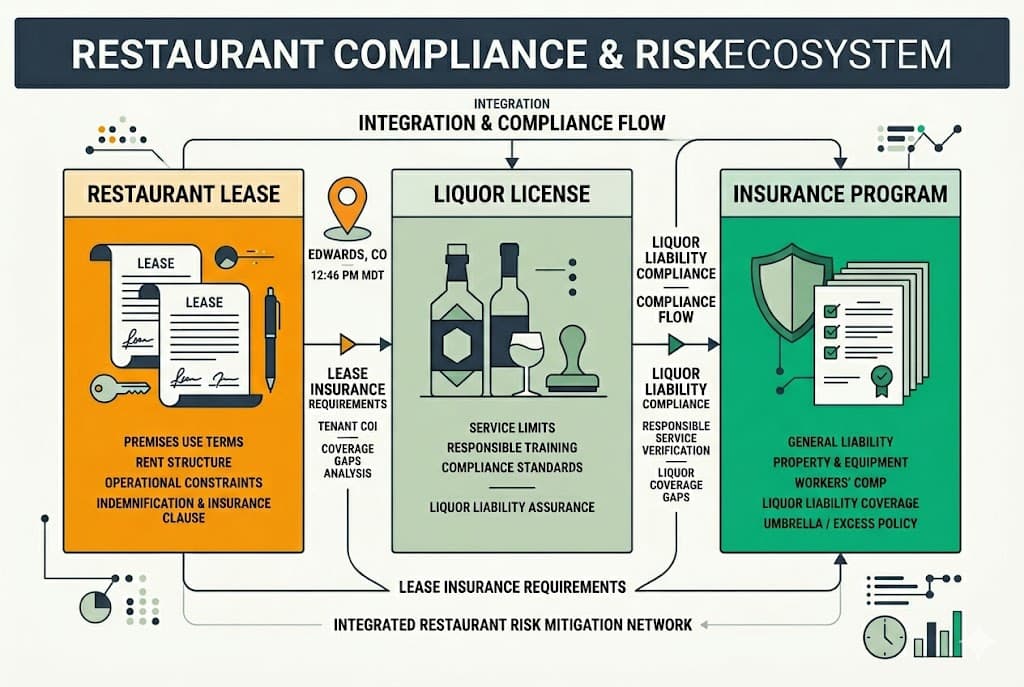
Most Commercial Restaurant Leases Require:
General Liability with specific minimum limits
Usually $1M/$2M, sometimes higher for anchor tenants or high-traffic locations
Additional Insured endorsement
Naming the landlord, property management company, and sometimes the mortgage holder
Waiver of Subrogation
Preventing your insurer from suing the landlord after paying your claim
Primary and Non-Contributory language
Making your policy respond first, before the landlord’s policy
Workers Compensation
Meeting state requirements for all W-2 employees
Commercial Property with tenant improvement coverage
Covering your buildout, equipment, and fixtures
Business Interruption
Ensuring rent continues to be paid to the landlord even if you can’t operate
30-Day Notice of Cancellation
Giving the landlord advance warning if your policy is cancelled or non-renewed
What Happens If Your Policy Doesn't Match Your Lease
- You can be evicted for breach of lease — and your landlord has the legal right to do so
- Your landlord can place forced insurance on your space at significantly higher premiums that you’re required to reimburse
- In a claim, the landlord can argue your insurance gap caused or contributed to their loss
- At renewal, the landlord can refuse to renew your lease citing non-compliance
The Liquor License Insurance Trap
Most state liquor authorities require liquor liability coverage as a condition of your license. But the specific limits and endorsements vary by state. California requires different limits than Texas. Colorado has its own requirements. Your liquor license could be revoked for non-compliance — and most restaurant owners don't know the exact requirements for their state.
You need to satisfy both your state's liquor authority and your lease requirements. Whichever requires higher limits wins. Many restaurant owners discover this gap only when the liquor authority audits them or when a claim is filed.
When was the last time anyone actually compared your lease's insurance requirements to your current policy? Most restaurant owners find out about the gap only when the landlord does an audit — or when there's a claim.
For more on liquor liability requirements, read our detailed guide on whether restaurants need liquor liability insurance. For a full breakdown of what these coverages cost, see our restaurant insurance cost guide for 2026.
Section summary
The 8 Mistakes Restaurant Owners Make With Insurance
These are the coverage gaps and process failures we see repeatedly across restaurant policy reviews. Each one is preventable. Each one traces back to coverage that was never re-matched to current operations.
🏗️ Is your property limit set against today’s rebuild cost — or the buildout invoice from when you opened?
Commercial property and tenant-improvement limits are the foundation of your restaurant’s recovery after a fire or major loss. But most operators insure the buildout at what it cost to construct years ago, or at the original loan amount — not at what it would cost to rebuild the same kitchen, dining room, and equipment package at current construction prices. When a covered loss forces a full rebuild, the gap between the policy limit and the actual rebuild cost is paid out of ownership’s pocket while the doors stay closed.
How to fix this: Re-price your building, tenant improvements, and equipment to current replacement cost — not original buildout cost or loan balance. Have the limit reviewed against current construction cost data at every renewal, and apply an inflation-guard endorsement between full reviews.
Restaurants insured at original build-out cost or original loan amount carry the full rebuild gap as ownership exposure. Construction costs across most markets have risen materially since the buildout was first underwritten. The question worth asking at every renewal: is your property limit set against current rebuild cost — or against an appraisal from before the cost curve moved?
📉 If a kitchen fire closed your doors for four months tomorrow, would the income coverage actually last that long?
Business interruption replaces lost net income and the fixed costs that continue when a covered loss shuts the restaurant down — rent, equipment financing, key-staff payroll. The limit is only as good as the revenue figure it was sized against. Most operators set it at original opening and never re-rate it, so a restaurant that has grown materially is carrying a coverage period built for a smaller, younger business.
How to fix this: Recalculate your BI limit against current trailing revenue and a realistic repair-and-re-permitting timeline for your buildout. Size it to 12–18 months of continuing fixed obligations plus net profit, and update it every renewal as revenue grows.
Most restaurant BI limits haven’t been re-rated against current revenue since the original underwriting. Revenue grows; the limit doesn’t. The question worth asking: if a kitchen fire closed the restaurant for four months tomorrow, would your BI limit cover 12-18 months of continuing rent, payroll, and net profit — or would coverage run out before the build-out repair was complete?
🍸 Does your liquor liability limit reflect this year’s bar revenue — or the day you first opened?
Liquor liability responds to the dram shop and over-service claims your general liability policy specifically excludes. As bar revenue, operating hours, and late-night service grow over the years, the exposure grows with them — but the limit often stays frozen at whatever the prior broker bound at opening. A single dram shop claim in an aggressively-enforced state can run well past an undersized limit.
How to fix this: Match your liquor liability limit to this year’s bar revenue, your current hours of operation, and your state’s dram shop exposure — not the limit set when the restaurant first opened. Confirm it satisfies both your lease and your state liquor authority, whichever is higher.
Bar revenue grows over years. Liquor liability limits often don’t. The question worth asking: does your current liquor liability limit reflect this year’s bar revenue, this year’s hours of operation, and your state’s dram shop exposure — or is it the limit your prior broker bound when the restaurant first opened?
⚙️ When did anyone last audit your workers comp experience modifier against your actual claims?
Your workers comp experience modifier (xmod) adjusts premium up or down based on how your claims history compares with similar restaurants — and it follows you for years. Miscoded claims, claims reserved at original estimate rather than final cost, and policies bound without the latest data all push the xmod higher than your real claims experience justifies. Most operators never see the calculation, so the drift goes unmanaged straight into the renewal premium.
How to fix this: Have your broker audit your xmod against the latest payroll and claims data, surface any miscoded or over-reserved claims dragging it higher, and dispute them before they compound into next year’s premium.
Workers comp experience modifiers drift over time. Miscoded claims, claims reserved at original-estimate-not-final-cost, and policies bound without the latest xmod data drive renewal premiums higher than current claims experience justifies. The question worth asking: when did your broker last audit your workers comp xmod against the latest payroll and claims data — and surface any miscoded claims that are dragging your xmod higher than it should be?
❄️ When the walk-in dies over a holiday weekend, does anything cover the spoiled inventory and the lost service?
Standard commercial property policies exclude mechanical and electrical breakdown of the kitchen equipment most likely to fail — walk-in compressors, hood systems, HVAC, dishwashers, POS infrastructure — treating it as wear-and-tear. Equipment breakdown coverage fills that exclusion, and for a full-service kitchen it also picks up the spoiled inventory and the lost income when a failure forces a closure. Without it, both the repair and the spoilage land on ownership.
How to fix this: Confirm your program carries equipment breakdown coverage tied to your total equipment value, and verify it includes a spoilage sub-limit for the inventory loss that follows a refrigeration failure.
Standard restaurant property policies exclude mechanical breakdown on the kitchen equipment most likely to fail. When a walk-in cooler dies over a holiday weekend or a hood system fails during dinner service, the standard property policy denies the claim. The question worth asking: does your current program carry equipment breakdown coverage — and does it include spoilage coverage for the inventory loss that follows?
☂️ Does your total liability stack actually clear your annual revenue plus a year of operating expenses?
Your general liability, liquor liability, and auto policies each stop at their own limits. An umbrella sits above all of them and adds catastrophic-claim protection at a small premium relative to raising each underlying line. For a full-service operator with active bar service, a fatal dram shop claim or a multi-person injury can exhaust primary limits and reach ownership assets — which is exactly the gap the umbrella exists to close.
How to fix this: Add an umbrella sized so your total liability stack — primary GL plus liquor liability plus umbrella — equals at least your annual revenue plus one year’s operating expenses. Step the limit up for active bar service or late-night hours.
Umbrella coverage adds limits at a meaningfully small premium relative to the excess exposure. The question worth asking is whether your total liability stack — primary GL plus liquor liability plus umbrella — equals at least your annual revenue plus one year’s operating expenses for an established full-service operator with active bar service.
💳 If your POS is breached, who absorbs the PCI fines and notification costs — the policy, or operating cash?
Restaurant POS systems and online-ordering platforms are among the most-targeted breach vectors in any small business, and they hold exactly the card data attackers want. A standard restaurant program excludes cyber events entirely unless cyber liability is scheduled — so the PCI fines, customer-notification costs, forensics, and reputational fallout after a payment-card compromise come straight out of operating cash. General liability does not respond to a data breach.
How to fix this: Add cyber liability sized to your payment-card volume and the customer data you hold, and confirm it includes breach response, notification costs, and PCI fine coverage. Keep your POS PCI-compliant and patched.
Restaurant POS systems and online ordering platforms are typical breach vectors. When a payment card compromise produces PCI fines, customer notification costs, and reputation damage, the standard restaurant program excludes these costs unless cyber liability is on the schedule. The question worth asking: does your current program carry cyber coverage sized to your payment card volume — or are payment-card breach costs sitting on the restaurant’s operating cash?
🚚 When an employee wrecks their own car on a supply run, whose policy actually pays?
The moment your restaurant does any delivery, off-site catering, or sends staff on supply runs and bank deposits, you have auto exposure for vehicles you don’t own. When an employee uses their personal car for restaurant business and causes an accident, their personal auto carrier typically denies the claim citing commercial use — and without hired and non-owned auto coverage, the restaurant is left exposed for the full amount.
How to fix this: Add hired and non-owned auto (HNOA) coverage sized to the exposure your delivery, catering, and errand operations actually create, with at least a $1M combined single limit. Layer commercial auto on top of any vehicles the business owns.
Restaurants with active delivery operations, catering off-site work, or staff bank-run responsibilities expose ownership when employees use personal vehicles for restaurant business. The personal auto carrier typically denies coverage for commercial use. The question worth asking: does your current program carry HNOA — and is the limit sized to the exposure your active delivery operations create?
Section summary
Premium Drivers
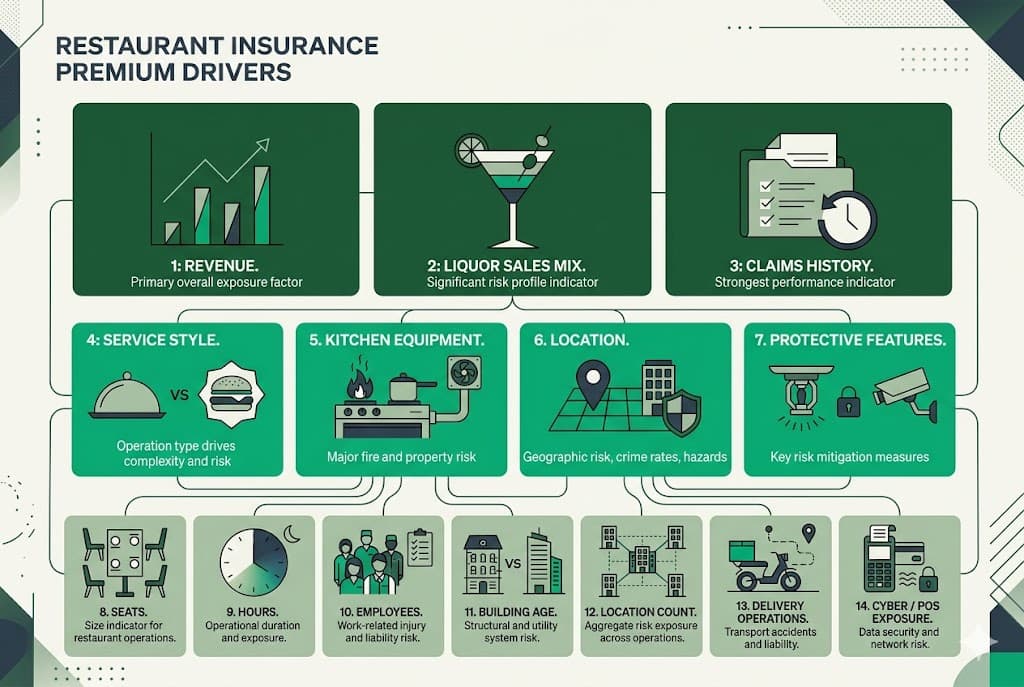
What Drives Your Restaurant Insurance Premium
The question worth asking before every renewal isn’t what your restaurant premium is. It’s which of these factors is moving your specific quote — and which ones your current broker isn’t even checking against your actual revenue, liquor sales mix, and claims history.
| Rating Factor | Impact on Premium | |
|---|---|---|
| Annual revenue + total insured value | CriticalThe largest single premium driver — scales with revenue and the property limit. | |
| Service style (full-service vs quick-serve vs fine dining) | SignificantFull-service and bar-forward concepts carry more GL and liquor exposure. | |
| Liquor sales mix (% beer/wine vs cocktails vs spirits) | CriticalHigher spirits and late-night sales drive liquor liability rate. | |
| Number of seats + occupancy capacity | SignificantMore seats and higher occupancy raise GL exposure. | |
| Claims history (last 5 years) | CriticalRecent losses drive renewal pricing up across lines. | |
| Geographic location (state liquor liability laws, dram shop exposure) | CriticalAggressively-enforced dram shop states carry materially higher liquor terms. | |
| Hours of operation + late-night service | SignificantLate-night and bar-close hours raise liquor and GL rate. | |
| Number of locations + multi-state operations | SignificantEach location and state adds its own property, liquor, and compliance load. | |
| Employee count + payroll | CriticalThe biggest workers compensation driver — scales with payroll. | |
| Kitchen equipment + fire suppression class | SignificantOpen-flame cooking and suppression class shape property rate. | |
| Building age + condition (HVAC, plumbing, electrical) | NotableAged systems raise property scrutiny and rate. | |
| Protective features (sprinklers, alarms, security) | NotableDocumented protective features earn credits on property + GL. | |
| Delivery operations (in-house drivers vs third-party) | SignificantActive delivery raises auto and HNOA exposure. | |
| Cyber / POS exposure (payment card volume) | NotableHigher card volume and online ordering raise cyber exposure. |
A complete restaurant insurance program typically includes these lines:
| Coverage | Purpose | Typical Limits | |
|---|---|---|---|
| General Liability | Third-party injuries and property damage at your locations | $1M occurrence / $2M aggregate | |
| Liquor Liability | Over-service and dram shop claims GL excludes | $1M per occurrence minimum | |
| Commercial Property + Business Interruption | Buildout, equipment, inventory, and lost income during closure | 100% replacement cost / 12–18 months BI | |
| Workers Compensation | Employee injuries — kitchen burns, cuts, slips | State statutory minimums | |
| Equipment Breakdown | Mechanical failure of refrigeration, HVAC, POS + spoilage | Aligned to equipment value + spoilage sub-limit | |
| Hired & Non-Owned Auto | Employee personal vehicles used for restaurant business | $1M combined single limit | |
| Umbrella / Excess Liability | Additional layer above GL, liquor, and auto | Annual revenue plus one year operating expenses | |
| Cyber Liability | Payment-card breach response, notification, PCI fines | $250K–$1M for established operators |
Restaurant premiums move on revenue, liquor sales mix, claims history, service style, hours of operation, and labor footprint — restaurant-specific operational details no generic quote can know. The program worth binding is the one matched to your current revenue, your liquor license, and your lease.
For a deeper breakdown of what drives restaurant premium in 2026, read our complete guide to restaurant insurance costs in 2026.
Section summary
Before the next renewal
Most restaurant programs are renewed against last year's declarations — without anyone matching coverage to current revenue, current liquor sales, or current lease obligations.
We pull your declarations, your liquor license, your lease, and your prior claims, match coverage line-by-line, and surface the gaps before bind — not after a dram shop claim or a kitchen fire closes the doors.
State-Specific Considerations
Restaurant insurance requirements — especially liquor liability and workers comp — vary significantly by state. Here are key considerations for some of the states where we place the most restaurant coverage:
California
Strict liquor liability requirements through the ABC (Alcoholic Beverage Control). California has some of the highest workers comp rates in the country for restaurant classifications. Prop 22 considerations affect delivery driver classification and insurance requirements. Earthquake exposure adds property cost for many locations. California restaurant insurance requirements
Texas
laws are heavily enforced through TABC, with significant penalties for serving visibly intoxicated patrons. Eastern regions face substantial wind and hail property exposure. Texas has multiple liquor license classes with varying insurance requirements. Workers comp is technically optional in Texas, but going without it exposes the business owner to unlimited personal liability. Texas restaurant insurance considerations
Colorado
Altitude considerations affect equipment performance and maintenance. Colorado's strong craft brewery and distillery culture creates unique liquor liability pricing dynamics. Mountain town restaurants face seasonal exposure with dramatic swings in revenue and staffing. Hail exposure in the Front Range adds to property costs. Colorado restaurant insurance requirements
Illinois & Georgia
Both states actively enforce dram shop laws with specific liquor liability minimums that vary by municipality. Chicago and Atlanta have among the highest restaurant insurance costs in their respective states due to litigation frequency and high jury awards. City-specific requirements often exceed state minimums. Illinois restaurant insurance | Georgia restaurant insurance
We serve restaurants across 29 states, and our agents understand the specific liquor authority requirements, dram shop laws, and workers comp regulations in each one. See all 29 states we serve to find state-specific information for your restaurant.
Frequently Asked Questions
How much restaurant insurance do I actually need?
Does my GL policy cover alcohol-related claims?
If I only use third-party delivery apps, do I still need auto coverage?
What happens if my kitchen equipment fails and I lose my inventory?
How is Business Interruption coverage actually calculated?
Do I need separate insurance for each location I own?
What’s the difference between replacement cost and actual cash value for restaurant equipment?
How does my liquor license affect my insurance requirements?
Do I need umbrella coverage if I already have $1M/$2M GL?
What documents do I need to get a restaurant insurance quote?
We Review Your Lease & Liquor Requirements Before You Bind

Most insurance agents quote restaurants based on a generic application: restaurant type, revenue, seating capacity, done. They never see the lease that dictates your actual insurance requirements. They never verify whether your liquor liability coverage meets your state's liquor authority minimums. The result? Your policy is built to satisfy a standard checklist, not the specific obligations in your lease and liquor license.
At Insurance Service 365, we read your lease before quoting your coverage. We verify your liquor license requirements against your policy. We compare your landlord's insurance requirements to what your policy actually provides. We identify every gap that could affect your liquor license renewal, your lease compliance, or your ability to collect on a claim. Then we present our findings on a video call, in plain English — no jargon, no pressure.
This is what we call a consultative review, and it's included at no cost for every restaurant client. It's also why restaurant owners who work with us rarely have coverage surprises at claims time. When we say your policy matches your lease and your liquor requirements, it does — because we've read all three.
Watch Patrick Walk Through a Real Restaurant Policy Review
See exactly what a consultative review looks like — from lease analysis to liquor liability verification to coverage recommendation — in under 10 minutes.
This consultative approach is the same process we bring to contractor insurance for restaurant buildouts and renovations and commercial property insurance for restaurant landlords and building owners. For restaurants in mixed-use buildings with HOA governance, we also handle HOA insurance for restaurants in mixed-use buildings.
Need to finance equipment, a buildout, or working capital for a new location? Restaurant equipment financing and working capital loans may be an option worth exploring.
Bottom line

Ready to Take the Next Step?
Whether you're running a single location with a full bar or managing multiple addresses across your group, these tools will help you make informed decisions.
Ready for a policy review? Get Restaurant Coverage →