
Why Your COI Gets Rejected (When Your Coverage Is Fine)

Last updated: May 26, 2026
Key Takeaway
Most COI rejections aren't about coverage — they're about paperwork. Additional insured endorsements, entity name mismatches, and missing waiver of subrogation account for the majority. A construction-focused agent who reads the contract before binding your policy can eliminate most rejections.
Why does my certificate of insurance keep getting rejected?
The most common reasons are: missing additional insured endorsements (CG 20 10 / CG 20 37), incorrect entity names, no waiver of subrogation, missing primary and non-contributory language, and coverage limits too low for the project. Most rejections are fixable quickly with the right agent — or avoidable entirely if your agent reads the contract before binding.
FOR CONTRACTORS
Fourth rejection in two months. The coverage is fine. The paperwork isn't.
When the GL is in force, the workers comp is current, and the umbrella sits where it should — but the COI still keeps coming back kicked — the gap isn't the policy. It's whether the endorsements named on the certificate are actually attached to the policy form. That gap is invisible until the GC's compliance platform finds it.
A drywall sub called us on a Thursday because his GC kicked back his certificate of insurance for the fourth time in two months. Different GCs, different jobs — same result. He had a million-dollar GL policy, current workers comp, and a $2 million umbrella. On paper, he was fully covered.
His COI still got rejected every time.
The pattern is one we see weekly: a contractor's COI doesn't get rejected because the coverage is missing. It gets rejected because the paperwork doesn't match what the contract requires. And the gap between "having coverage" and "proving coverage the way a GC demands" is where most contractors lose jobs, lose time, and lose money. The fix lives in the policy form, not the certificate.
90%+
material misrepresentation rate found on vendor certificates of insurance reviewed across hundreds of insurance policies — the gap between certificate and policy is the industry norm, not the exception
IRMI expert commentary, "Avoiding Common Insurance Certificate Errors in Contracting Services"
8.3M
U.S. construction payroll employment as of August 2024 — the universe of COIs in motion every day across commercial job sites
BLS Current Employment Statistics, August 2024
36K+
participating organizations across 100+ countries using ACORD standards — every certificate sits inside the same standardized exchange, which is why mismatches get caught automatically
ACORD, organization profile, 2024
The 7 Most Common Rejection Reasons
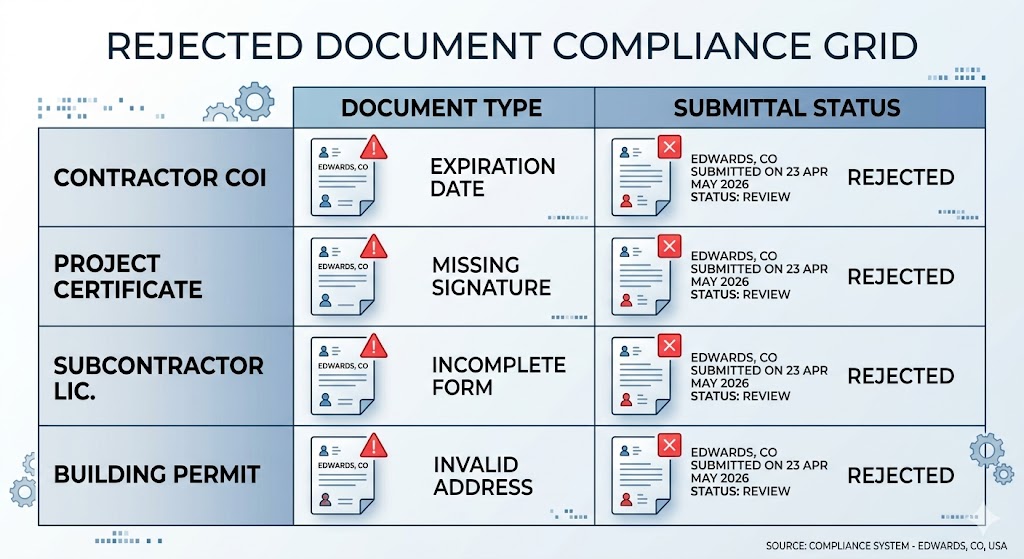
Compliance platforms reject certificates for the same seven reasons across nearly every commercial project. The table below maps each reason with what actually gets rejected and how heavily it weighs in compliance review.
Rejection Drivers
The 7 Most Common COI Rejection Reasons
Compliance platforms reject certificates for the same seven reasons across nearly every commercial project. Here's what actually gets rejected, and how heavily each one weighs at compliance time.
| Rating Factor | Impact on Premium | |
|---|---|---|
| Missing additional insured endorsement (CG 20 10 / CG 20 37) | CriticalMost common rejection trigger — endorsement noted but not actually attached to policy form | |
| Wrong entity name on the certificate | CriticalCompliance platforms flag automatically; "Pinnacle Construction" ≠ "Pinnacle Construction Services, LLC" | |
| No waiver of subrogation endorsement | CriticalNot optional on most commercial work; description-field text doesn't substitute for endorsement | |
| Primary and non-contributory language missing | SignificantEndorsement that puts your policy first; GCs reject without it regardless of limits | |
| Coverage limits too low for project size | SignificantLarger commercial work demands $2M/$4M or umbrella stacks above standard $1M/$2M | |
| Per-project vs. per-occurrence aggregate | NotableLarger commercial work demands per-project aggregate endorsement; without it, certificate gets kicked | |
| Expired or mismatched policy dates | NotablePolicy must cover full project timeline; mid-project lapse triggers automatic compliance flag |
The pattern: most rejections aren't coverage gaps. They're alignment gaps between what the certificate says and what the policy form actually carries. The fix happens before bind, not after the rejection.
A few notes on how to read the table. Additional insured endorsement gaps are the single most common rejection driver — and they're rarely fixed by checking a box on the ACORD form. The endorsement has to actually be attached to the underlying policy. Entity name mismatches are mechanical but unforgiving — compliance platforms flag them automatically. Per-project aggregate is becoming a default requirement on larger commercial work. And expired or short-dated policies are flagged the moment the compliance system reads the policy expiration against the project timeline.
Before the next rejection
Tired of sending COIs that keep getting kicked back?
We pull your current policy form (not just the certificate), confirm which endorsements are actually attached, and surface the gaps before the next compliance platform finds them for you.
“Your COI doesn't get rejected because you don't have enough insurance. It gets rejected because the paperwork doesn't match what the contract requires.”
— Bobby Friel · Partner, Direct Insurance Services
What Most Agents Send vs. What Compliance Wants
The gap between a certificate that clears compliance and a certificate that gets kicked back is rarely about coverage. It's about whether the endorsements named on the certificate are actually attached to the policy form. Five places where that gap shows up:
What Most Agents Send
- ×ACORD 25 with "additional insured" noted in the description field
- ×Loose entity name match — close enough but not exact
- ×Ongoing operations AI only (CG 20 10), no completed operations (CG 20 37)
- ×No endorsement copies attached to the certificate transmission
- ×Standard form generated from a template — no contract-specific customization
What the GC Compliance Platform Actually Wants
- ✓CG 20 10 + CG 20 37 endorsements attached to the policy form itself
- ✓Exact entity name match to the contract — every word, every suffix, every comma
- ✓Ongoing AND completed operations AI both endorsed on the policy
- ✓Endorsement copies available on request for the compliance audit trail
- ✓Contract-matched policy structure verified before bind, not after rejection

Contractor Scenario
OPERATOR SCENARIO
Scenario
Imagine you've been carrying a $1M GL policy with a $2M umbrella for two years. Your COI has been kicked back by three different GCs in two months. Your current agent keeps telling you to "talk to the compliance team" — they don't see what's wrong with the certificate they keep sending.
What we did
What changes for you if the additional insured was never actually endorsed on the policy form — just noted on the certificate? When does that gap surface — at audit, at the compliance check, or at the claim?
🎯 The Outcome
Could every COI you've sent for the past two years already be the gap that voids your additional insured status when it actually matters?
The 12-Item COI Verification Checklist
Before any certificate goes out, twelve items get verified against the contract — not assumed. A construction-focused agent runs through this list every time. An agent who doesn't will keep sending certificates that get kicked back.
01
🏢Named Insured Matches Legal Entity Exactly
Your business name on the certificate must match your legal entity exactly — including LLC, Inc., or commas. Mismatches between the named insured and your actual entity get flagged by compliance platforms automatically.
02
🏗️Additional Insured Matches GC's Legal Entity Exactly
The GC's legal name on the certificate must match the contract and the W-9 — every word, every comma, every suffix. Loose matches get rejected.
03
🛡️CG 20 10 Endorsement on the Policy
Additional Insured – Owners, Lessees or Contractors – Scheduled Person Or Organization (ongoing operations). This is the ISO form that adds the GC as additional insured for the work in progress. Must be attached to the policy form, not just noted on the certificate.
04
🛡️CG 20 37 Endorsement on the Policy
Additional Insured – Owners, Lessees or Contractors – Completed Operations. The companion endorsement that extends the AI status to claims arising from completed work. Often missing on policies that carry CG 20 10 only.
05
⚖️Waiver of Subrogation Endorsement on the Policy
Blanket or project-specific waiver attached to the policy form. Writing "waiver of subrogation applies" in the certificate description field does nothing if the endorsement isn't actually on the policy.
06
📄Primary and Non-Contributory Endorsement
The endorsement that puts your policy first in the payment order, before the GC's own coverage responds. Most commercial work demands this language as a contract default.
07
📊GL Limits Meet or Exceed Contract Requirements
Per-occurrence and aggregate limits both checked against the contract floor. Standard floor is $1M/$2M; larger commercial work demands $2M/$4M or umbrella stacks layered above.
08
👷Workers Comp Limits Meet Contract Requirements
Statutory limits in your state plus any employer's liability minimums the contract demands. Some commercial contracts require specific employer's liability stacks above the statutory floor.
09
🌂Umbrella / Excess Limits Meet Contract Requirements
Where the contract demands umbrella coverage stacked above the GL, the umbrella policy must be in force and reflected on the certificate alongside the underlying lines.
10
📅Policy Dates Cover Full Project Timeline
Certificate dates must cover the project end date, not just the start. A policy expiring mid-project triggers an automatic flag the moment compliance reads the dates against the project timeline.
11
📁Per-Project Aggregate Endorsement (Where Required)
On larger commercial projects, the contract may demand a per-project aggregate endorsement that gives each project its own separate aggregate limit. Without it, claims on one project can exhaust the aggregate for all other concurrent projects.
12
📍Certificate Holder Name and Address Correct
The GC's entity name and address as certificate holder must match the contract exactly. Mismatches here are mechanical but unforgiving — compliance platforms flag them automatically.
The Contractor Insurance Guide includes state-specific requirements for the service area. Read it before your next bid: Contractor Insurance Guide.
The 12-item verify checklist
Want the verify checklist your agent should be running?
We walk through every line of the checklist against the contract before the certificate goes out — every entity name, every endorsement, every limit. Same workflow on every COI.
How We Handle COIs Differently
The standard agent workflow is: bind the policy, generate a certificate from a template, send it, wait for the rejection, scramble to fix what should have been right the first time. The construction-focused workflow is different:
Before bind: the contract or the GC's insurance requirements get pulled and read first. The policy we're quoting gets matched against those requirements. If the carrier can't meet a specific endorsement requirement, that gets surfaced before binding — not after.
At certificate issue: every certificate goes through a verification step against the contract. Entity names checked. Endorsements confirmed attached to the policy form, not just noted in the description field. Endorsement copies attached when the GC compliance team requires them.
Turnaround: the certificate ships once the policy is structured against the contract — typically 24 to 48 hours from first call when docs are ready, faster on follow-on jobs where the policy is already in force and only an endorsement update or a new certificate holder is needed. The certificate is the reflection of the policy, not a separate document being negotiated against the contract.
30+ A-rated carriers. 29 states. Verification before send. If you're a contractor in Colorado, Texas, California, or any of the other states we serve, the COI requirements your GC throws at us aren't new.
FAQ
How long does it take to get a COI after a policy is bound?
Typically within a few hours of bind. The verification step runs against the contract requirements before the certificate goes out, so there's no back-and-forth on the standard rejections — entity name match, endorsement confirmation, limits check.
Can my insurance agent fix a rejected COI?
They should be able to. But if the agent's the reason it got rejected in the first place, the same rejection pattern tends to repeat. The contractors we've reviewed whose previous agents kept sending bad certificates almost always had policies that lacked the underlying endorsements the certificates referenced — fixing the certificate alone doesn't solve that.
What does it cost to add additional insured and waiver of subrogation?
Most carriers include blanket additional insured and blanket waiver of subrogation at no extra cost or for a small endorsement fee. The bigger cost is not having them — losing a commercial bid because the endorsement that costs less than a fast-food order isn't on the policy.
Do I need a separate COI for every job?
Depends on the GC. Some accept a blanket COI. Others want a project-specific certificate listing their company as the certificate holder with a unique project reference. Either way, the verification step runs before send.
What's the difference between additional insured and certificate holder?
Certificate holder means the GC receives a copy of the certificate and gets notified if the policy cancels. Additional insured means the GC is actually covered under your policy for claims arising from your work. Certificate holder is informational. Additional insured is real coverage. Commercial GCs want both.
The Bottom Line
If the contractor sitting in the parking lot with a rejected COI is you — or if your bids keep losing because the insurance paperwork can't meet contract requirements — the fix isn't a different certificate. It's a different policy structure, contract-matched at bind. One application. 30+ carriers. Certificates that actually clear compliance because the policy already carries what the certificate references.
We serve contractors in California, Georgia, Virginia, and across the rest of our 29 service states. For the speed conversation — and why same-day binding without contract review is the gap that causes most rejections — see why speed without review costs you jobs. For the foundational definitional layer, see what a Certificate of Insurance actually is. And if a COI rejection is holding up a project and you need funding to bridge the gap, that's a separate workstream we can connect you to.
Want to see what your coverage should look like for the jobs you're bidding? Use our Contractor Insurance Risk Calculator, then we'll review the contract, confirm the endorsements are actually on the policy, and walk through the gaps before the next COI request lands.
The contractor's question
Not "what fixed this rejection." The right question is "what's actually endorsed on my policy form right now, and would the next compliance platform find a gap I haven't seen yet?" The certificate reflects the policy. If the policy isn't right, no amount of certificate editing will hold up at the compliance check or at the claim.
About the Author

Bobby Friel
Partner, Direct Insurance Services
Bobby Friel is a partner at Direct Insurance Services, where Patrick Henigan and the licensed team handle all quoting, policy reviews, and binding. Bobby runs the commercial division's marketing, content, and client outreach — helping contractors, HOA boards, restaurant owners, and commercial landlords across 29 states find the right coverage through Insurance Service 365.
Related Coverage
Explore Related Coverage Options
🔨 The Complete Contractor Insurance Guide 2026
What every contractor needs to know about general liability, workers comp, commercial auto, tools coverage, and the COI requirements that kill jobs.
Read the Free Guide →
Ready When You Are
Ready When You Are
No pressure. No obligation. Just real quotes from 30+ carriers, reviewed on video so you understand exactly what you're buying.
Takes ~2 minutes · Contract review included · Video walkthrough on every option