
Commercial Insurance Guide 2026: Lines, Mistakes & Gaps
What the universal commercial coverage stack actually does, where it leaves gaps, and which lines a real business operation actually carries. Written by Bobby Friel and the Direct Insurance Services team.

Bobby Friel
Partner, Direct Insurance Services
What brought you here?
Most established business owners don't pick up a guide on commercial insurance because they're curious. They picked it up because something just happened — a renewal proposal landed 28% above last year and the CFO flagged it for review before sign-off, a contract review surfaced two pages of insurance requirements the current policy doesn't meet, a claim came in and the carrier's denial letter showed an exclusion nobody had read, or a buyer's due diligence asked for documentation the current broker can't produce.
Who This Guide Is For
- Established business owners running real operations ($1M+ annual revenue, 10+ employees) reviewing their commercial program before the next renewal
- Operations leads and CFOs auditing the current program against actual revenue, claims experience, and contract obligations
- Founders preparing for a buyer due-diligence review and realizing the insurance documentation hasn't been re-rated in years
- Multi-location operators managing commercial coverage across more than one address or state
- Business owners whose contracts, leases, or vendor agreements require specific coverage their current policy doesn't reflect
$502 billion
in U.S. commercial lines direct premiums written in 2024 — up 4.0% over the prior year as carriers re-rated exposure
S&P Global Market Intelligence, 2025
6.3 million
U.S. employer firms — businesses with paid employees and real commercial liability exposure
SBA Office of Advocacy, 2024 Small Business Profile
$51 million
median U.S. corporate nuclear verdict in 2024, up from $44 million in 2023 as nuclear verdicts hit a record 135 cases
Marathon Strategies, 2025 Corporate Nuclear Verdicts Report
Case Study: Established Mid-Market Operator — Gaps Closed Before a Covered Loss
Commercial Scenario
OPERATOR SCENARIO
Scenario
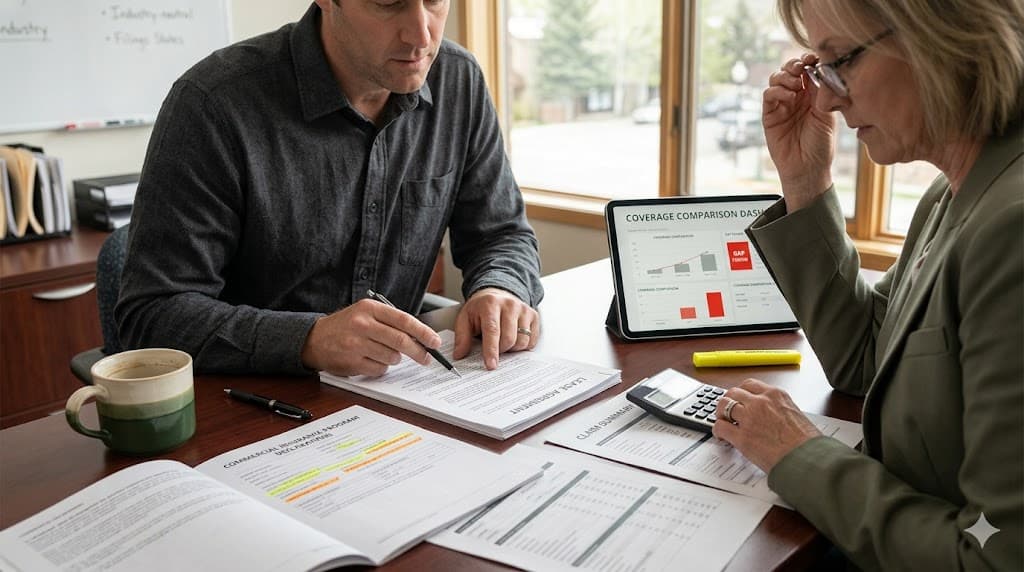
Established mid-market business with three operating locations across two states had been on the same commercial program for four renewal cycles. Revenue had grown materially over those four years, the employee count had expanded, and the operator had added a third location during the prior year. The current broker's renewal proposal was silent on the revenue growth, silent on the expanded payroll, silent on the third location's lease requirements, and silent on the buyer due-diligence review the owner was preparing for in twelve months.
The renewal landed with the same limits the prior broker had bound at original placement — including a general liability limit that hadn't been re-rated against current revenue, a property limit set against the original buildout cost (not current replacement cost), a workers comp experience modifier the broker hadn't audited, and a cyber liability sub-limit the operator wasn't sure they even carried.
What we did
Pulled the current declarations, the three location leases, the buyer due-diligence checklist the owner was preparing for, and the last four years of claims. Re-rated general liability against current revenue and current operations. Repriced commercial property at current replacement cost using current construction cost data. Audited the workers comp experience modifier and identified two miscoded claims dragging the xmod higher than current claims experience justified. Confirmed cyber liability coverage scope against the operator's actual payment card volume and customer data exposure. Surfaced two contract clauses in the third location's lease that required additional insured language the current policy didn't carry. Aligned the commercial umbrella against current annual revenue plus one year's operating expenses.
🎯 The Outcome
Bound a rebuilt program matched to current revenue, current operations, current claims experience, and current contract obligations. Closed the coverage gaps before any covered loss could expose them. Brought the program into alignment with the buyer due-diligence checklist so the upcoming review would surface clean documentation rather than gaps. The owner approved a rebuilt program at renewal — not a rubber-stamp on the same limits the prior broker had been auto-rolling for four cycles.
The Eight Lines Every Business Carries
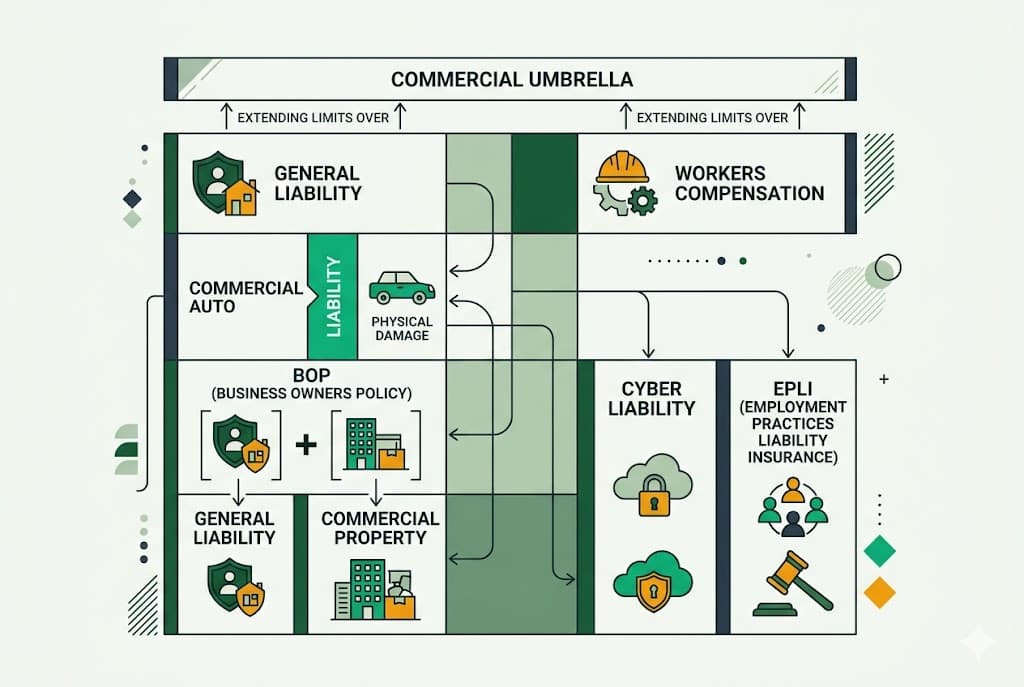
A commercial program isn't a single policy — it's a stack of interlocking lines, each with its own triggers, limits, and conditions. Here are the eight that carry most established commercial exposure, and the question each one answers when something goes wrong.
01
⚖️General Liability (GL)
What it covers: Third-party bodily injury, property damage, advertising injury, and personal injury claims arising from your operations, products, or premises. Limits: $1M per occurrence / $2M aggregate minimum for established operators — higher for higher-revenue or higher-exposure operations. The question this answers when something goes wrong: When a customer slips on your premises, a contractor damages a client's property during a job, or an advertising claim alleges trademark infringement, does your GL respond with adequate limits — or does the claim exhaust primary coverage and land on business assets?
02
🏢Commercial Property
What it covers: Building (if owned), tenant improvements, equipment, inventory, business personal property, and the income replacement when a covered loss forces closure — including business interruption tied to property loss. Limits: 100% of replacement cost for property; business interruption sized to current revenue plus continuing fixed obligations across a realistic recovery timeline. The question this answers: When a fire, water damage, or covered event forces a multi-month closure, does your property limit reflect current replacement cost AND does your business interruption cover continuing rent, payroll, and net profit for the full repair timeline?
03
📦Business Owner's Policy (BOP)
What it covers: A packaged policy bundling commercial property, general liability, and business interruption for small-to-mid commercial operators — streamlined underwriting at favorable rates for qualifying businesses. Limits: Varies by carrier; a BOP works well for operators in the $1M–$5M revenue range with standard exposure profiles, while higher-exposure operators typically need standalone GL and Property. The question this answers: Does a BOP fit your actual operations — or does your exposure profile (high-revenue, high-employee-count, multi-location, regulated industry) push you out of BOP eligibility into standalone commercial lines?
04
🦺Workers Compensation
What it covers: Medical care, lost wages, disability, and rehabilitation for employees injured on the job — required by law in nearly every state for businesses with employees. Limits: State statutory minimums; coverage is governed by state workers comp law, not by the policy. The question this answers: When an employee is injured tomorrow, does your workers comp respond cleanly — and is your experience modifier being managed before it drives next year’s renewal premium up?
05
🚚Commercial Auto
What it covers: Liability and physical damage for business-owned vehicles, plus hired and non-owned auto coverage for employee personal vehicles used for business and rental vehicles used for operations. Limits: $1M combined single limit minimum for business-owned vehicles; hired and non-owned auto for any business with employees using personal vehicles for work. The question this answers: When an employee causes an accident using a personal vehicle on business — a delivery run, supply pickup, off-site work, bank deposit — does your HNOA respond, or does the personal auto carrier deny coverage citing commercial use?
06
☂️Commercial Umbrella / Excess Liability
What it covers: Additional limits above general liability, commercial auto, and other primary liability policies — layering over the entire commercial program. Limits: Annual revenue plus one year's operating expenses at minimum for established operators; higher for higher-exposure operations or contract-required limits. The question this answers: When a catastrophic claim exhausts primary GL or auto limits, does your commercial umbrella respond with adequate excess coverage — or does the gap become a business ownership exposure event?
07
💻Cyber Liability
What it covers: Breach response, ransomware recovery, business interruption from cyber events, third-party claims arising from network compromise, and regulatory exposure under privacy laws (HIPAA, PCI-DSS, state privacy statutes). Limits: Business-specific based on records held, payment card volume, vendor exposure, and regulatory landscape — typically $250K–$5M for established mid-market operators. The question this answers: When a phishing attack succeeds, a vendor breach exposes your customer data, or a wire transfer goes to a fraudulent account, does your cyber coverage respond — or are the costs sitting on the operator's GL where they get denied?
08
🧑⚖️Employment Practices Liability (EPLI)
What it covers: Defense and damages for employment-related claims — wrongful termination, discrimination, harassment, retaliation, wage-and-hour claims, and failure-to-promote allegations. Limits: Per-claim and aggregate limits matched to employee count and revenue — typically $1M–$2M for established mid-market operators. The question this answers: When a current or former employee files a claim alleging discrimination, harassment, or wrongful termination, does your EPLI respond with adequate defense and indemnity limits — or is EPLI a coverage gap the operator didn't realize existed until the claim arrived?
Section summary
Which Guide Should You Read Next?
The lines above cover the universal commercial stack. The mistakes, claims experience, and renewal pain points vary materially by industry. Each of the five guides below goes deeper on a specific vertical's policy structure, common gaps, and operator-specific calibrated questions worth asking your current broker before the next renewal.
Restaurant
Avatar: Established restaurant operators with real liquor sales, $1M+ revenue, and full kitchen and front-of-house staff.
Common pain points: Liquor liability sub-limits, business interruption inadequacy, workers comp experience modifier drift, and lease compliance gaps.
Read the Restaurant Guide →HOA / Community Association
Avatar: Mid-to-large association boards with $500K+ master policies, board management, and meaningful reserves.
Common pain points: D&O coverage gaps, master property limits set against original construction cost, CC&R-required coverage the policy doesn't carry, and special-assessment exposure.
Read the HOA / Community Association Guide →Commercial Landlord
Avatar: Building owners with multi-tenant commercial property, $1M+ building value, and a real rent roll.
Common pain points: Loss-of-rents inadequacy, ordinance-or-law gaps, vacancy clauses, and tenant insurance gaps that fall back on the building owner.
Read the Commercial Landlord Guide →Contractor
Avatar: Established commercial contractors with real revenue and active subcontractor management.
Common pain points: Contract-required additional insured language, contract-required limits the policy doesn't carry, builder's risk gaps, and completed-operations exposure.
Read the Contractor Guide →Cyber (Healthcare / E-Commerce / Tech-SaaS)
Avatar: Established mid-market operators in healthcare/PHI, e-commerce/PCI, tech-SaaS, or professional services.
Common pain points: Notification cost sub-limits, ransomware sub-limit inadequacy, BEC sub-limit gaps, security control warranty mismatches, and regulatory exposure under state privacy laws.
Read the Cyber (Healthcare / E-Commerce / Tech-SaaS) Guide →If your business operates across multiple industries (a restaurant group that also owns its building, a contractor with significant cyber exposure from project management software, a professional services firm with multiple office leases), the most useful path is reviewing the relevant guides in combination — or having the full program reviewed against your actual operations during a consultative review.
Section summary
“Operators who don't get blindsided at claim time aren't the ones whose carrier said yes fastest — they're the ones whose agent read the contracts, the claims history, and the actual operations first.”
— Bobby Friel · Partner, Direct Insurance Services
What Most Insurance Agents Do for Commercial
- ×Quote from a generic questionnaire (revenue, industry, claims)
- ×Never read the actual contracts, leases, or vendor agreements
- ×Match limits to the prior policy, not to current revenue or current operations
- ×Treat sub-limits as boilerplate, not as the actual exposure caps they are
- ×Find out about coverage gaps when a claim hits, a contract is breached, or a buyer's due diligence surfaces them
What We Do
- ✓Read your current declarations, leases, vendor contracts, customer contracts, and prior claims before quoting
- ✓Re-rate primary limits against current revenue and current operations
- ✓Verify contract-required coverage (additional insured, primary/non-contributory, waiver of subrogation, minimum limits) is in place
- ✓Audit sub-limits against actual exposure — cyber records held, BEC vendor payment volume, regulatory landscape, dependent BI vendor list
- ✓Confirm workers comp experience modifier against current claims data and surface miscoded claims
- ✓Size commercial umbrella against current annual revenue plus one year's operating expenses
- ✓Present findings to the operator on video, in plain English
8 Mistakes Most Operators Make
These are the eight most common gaps we find in commercial program reviews across industries. Each one is preventable. Each one, left unaddressed, can convert a manageable claim into an uninsured loss.
When was the last time your commercial limits were re-rated against your actual current revenue?
Most commercial programs auto-renew against the prior year's declarations. Revenue grows; limits don't. The result is a program priced and structured for the business you were three or four years ago — not the one you run today. When a large claim hits, the gap between the limits your prior broker bound and the limits your current revenue demands lands on business assets.
How we fix this: Re-rate primary GL, property, and umbrella against current trailing revenue at every renewal cycle — not just the year you first placed the program.
When was the last time anyone compared your current revenue and operations against the limits your prior broker bound at original placement?
Are your property limits set against current replacement cost — or against an appraisal from before construction costs moved?
Property limits set to the original loan amount or original buildout cost carry the rebuild gap as ownership exposure as construction costs rise. A coinsurance penalty can compound the problem — insuring below the required percentage of value reduces every claim payment, not just total losses.
How we fix this: Reprice property at current replacement cost using current construction cost data at every renewal, and confirm an inflation-guard endorsement is keeping insured values current between renewals.
If a covered property loss forced a full rebuild tomorrow, would your property limit reflect current construction cost in your market — or would the gap land on business assets?
Does your business interruption limit cover the realistic recovery timeline for your specific operations?
A business interruption period that defaults to 12 months may be inadequate for operations requiring extensive buildout, equipment replacement, or regulatory re-certification before reopening. The coverage can run out months before the doors actually reopen.
How we fix this: Size business interruption to current revenue plus continuing fixed obligations across a realistic recovery period for your specific build-out — not a default term.
If a covered event closed operations for the full realistic recovery period your build-out actually requires, would your BI cover continuing rent, payroll, and net profit through reopening — or would coverage run out before the doors reopened?
When did your broker last audit your workers comp experience modifier against actual claims experience?
Experience modifiers drift over time. Miscoded claims and policies bound without the latest xmod data drive renewal premiums higher than current claims experience justifies — and the operator pays the inflated premium every year until someone audits it.
How we fix this: Audit the experience modifier against current payroll and claims data at every renewal, and identify miscoded claims or stale reserves dragging the xmod higher than it should be.
When did your broker last surface any miscoded claims or stale reserves dragging your workers comp xmod higher than your actual current claims experience justifies?
Does your commercial umbrella reflect your current annual revenue plus one year's operating expenses?
An umbrella adds excess limits at a meaningfully small premium relative to the catastrophic exposure it covers. Umbrellas sized at original placement frequently haven't kept pace with revenue growth, leaving the gap between primary limits and the umbrella as the operator's exposure.
How we fix this: Size the umbrella against current revenue plus one year's operating expenses at minimum — higher for contract-required limits or higher-exposure operations.
When a catastrophic claim exhausts primary GL or auto limits, does your commercial umbrella respond with adequate excess coverage — or is the gap between primary limits and umbrella the operator's exposure event?
Does your current program carry cyber coverage sized to your actual records, vendor exposure, and regulatory landscape?
Cyber sub-limits set at original placement frequently haven't been re-rated against current records, current vendor footprint, or current regulatory exposure under state privacy laws. Many established operators carry a token cyber sub-limit bolted onto a package policy — or no cyber coverage at all — even as their digital exposure has grown.
How we fix this: Re-rate cyber against current records held, current payment card volume, current vendor exposure, and the current state privacy law landscape.
When the next phishing attack succeeds, the next vendor breach exposes customer data, or the next fraudulent wire transfer happens, does your cyber respond — or are breach costs sitting on the operator's general liability where they'll get denied?
When was the last time someone read your contracts against your actual policy to verify the contract-required coverage is in place?
Vendor contracts, leases, and customer contracts typically require specific coverage — additional insured language, primary and non-contributory wording, waiver of subrogation, and minimum limits. When the contract is breached because the coverage isn't in place, the gap lands on the operator at the worst possible moment.
How we fix this: Audit every active contract against current declarations and verify additional insured, primary and non-contributory, waiver of subrogation, and minimum-limit requirements are met before binding.
If a vendor or customer contract were enforced against your current policy tomorrow, would the contract-required coverage be in place — or has nobody read the policy against the contract since original placement?
When was the last time anyone read your current declarations against your current operations, claims experience, and contract obligations?
Auto-renewal is the default path; a line-by-line audit against current operations is the exception. The gap between the two is exactly where coverage surprises live — and they surface when a claim hits, a contract is enforced, or a buyer's due diligence asks for documentation the program can't produce.
How we fix this: Pull current declarations, current operations data, claims history, and active contracts at every renewal, and audit coverage line-by-line before binding.
When did your broker last pull your current declarations and audit them line-by-line against your current revenue, current operations, current claims experience, and active contracts — or has the program just been auto-rolling each cycle?
Section summary
Premium Drivers
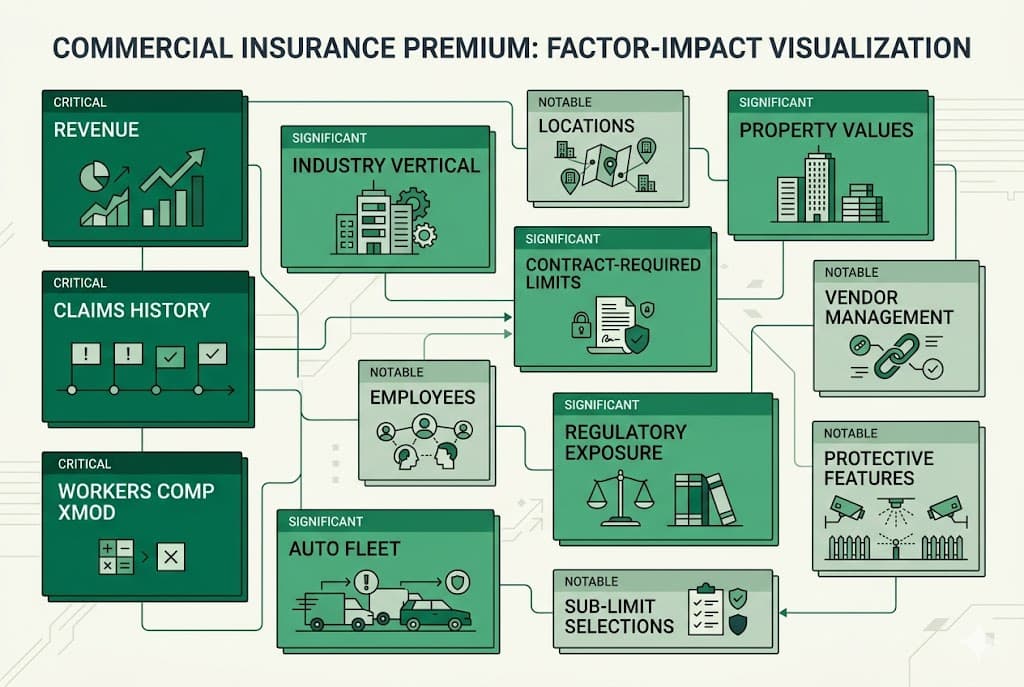
What Drives Your Commercial Insurance Premium
The question worth asking before every renewal isn't what your commercial premium is. It's which of these factors is moving your specific quote — and which ones your current broker isn't even checking against your actual revenue, operations, and claims experience.
| Rating Factor | Impact on Premium | |
|---|---|---|
| Annual revenue + total insured value | CriticalThe baseline driver — liability and property exposure scale with both. | |
| Industry vertical (SIC/NAICS class of business) | CriticalClass of business can be a multiple swing on identical revenue. | |
| Claims history (last 5 years) | CriticalA prior claim triggers tighter terms and specific underwriting questions at renewal. | |
| Employee count + payroll | CriticalHeadcount and payroll drive workers comp, EPLI, and social-engineering exposure. | |
| Number of locations + multi-state operations | SignificantEach location and state adds property, regulatory, and contract exposure. | |
| Property values + replacement-cost basis | SignificantReplacement-cost basis determines whether a rebuild lands fully covered. | |
| Workers comp experience modifier | SignificantAn unaudited xmod can inflate premium beyond what current claims justify. | |
| Contract-required limits (additional insured, primary/non-contributory) | SignificantContracts can demand limits and endorsements the base program lacks. | |
| Vendor management + third-party risk | SignificantEach vendor touching your data or operations is aggregated risk carriers probe. | |
| Cyber + data exposure (records held, PCI volume) | SignificantRecords held and card volume size notification and breach exposure. | |
| Auto fleet + driver MVRs | SignificantFleet size and driving records move commercial auto severity in a hard market. | |
| Regulatory exposure (HIPAA, PCI-DSS, state privacy laws) | NotableMulti-statute exposure raises the regulatory defense load. | |
| Protective features (sprinklers, alarms, security) | NotableDocumented protective features can unlock credits on property and liability. | |
| Sub-limit selections (ransomware, BEC, regulatory, dependent BI) | NotableSub-limit choices set the real exposure caps at claim time. |
There's no rate card for commercial insurance. The number that matters is the one mapped to your actual revenue, operations, claims experience, contracts, and exposure — which is exactly what our team reviews before quoting.
Section summary
Before the next renewal
Most commercial programs are renewed against last year's declarations — without anyone reading the contracts, the leases, or the prior claims line-by-line.
We pull your declarations, your contracts, your leases, and your prior claims, match coverage to your actual current operations, and surface the gaps before bind — not after a claim hits or a buyer's due diligence surfaces them.
How to Choose the Right Commercial Coverage Stack
Choosing the right commercial program isn't about finding the cheapest premium on a comparison sheet. It's about matching coverage to what your operation actually does, owns, owes, and has experienced. Here is the order our team works through before recommending a program.
Start with the declarations and the last three years of claims history. The declarations tell us what you currently carry; the claims history tells us how the program has actually performed. Then audit current revenue and operations against current limits — because a program bound at original placement is almost never sized for the business three or four renewal cycles later.
Next, read the contracts. Vendor agreements, leases, and customer contracts routinely require specific language — wording, , and minimum limits — that the base program may not actually carry. Check the sub-limits against real exposure (cyber, BEC, regulatory, dependent business interruption), confirm the workers comp against current claims data, and size the against current annual revenue plus one year's operating expenses.
The output of that process isn't a single number — it's a program where every line is matched to a real exposure and every contract obligation is actually met. A policy that wins on premium but fails these checks isn't the right policy; it's a gap waiting to surface at claim time.
What We Review Before You Bind

Most insurance agents quote commercial coverage from a short application: industry, revenue, claims, done. They never read the leases, the vendor contracts, the customer agreements, or the prior claims that actually drive coverage fit. We do it differently. Before we issue a proposal, our team reviews every quote against the underlying operation — and we walk you through what we found.
Declarations and operations review
We pull your current declarations and map every line against your actual current revenue, payroll, locations, and operations. Where a limit was sized for the business you were three renewals ago, we re-rate it against the business you run today.
Contract and lease review
We read your active vendor contracts, leases, and customer agreements and verify the contract-required coverage — status, primary and non-contributory wording, waiver of subrogation, and minimum limits — is actually in place. A contract requirement the policy doesn't meet is a breach waiting to surface.
Claims history and experience modifier review
We audit the last several years of claims and your workers comp experience modifier — surfacing miscoded claims or stale reserves dragging the xmod higher than current claims experience justifies, so you stop paying for losses that aren't actually yours.
Coverage gap surface
We check the sub-limits against real exposure — against a realistic recovery timeline, cyber against current records and vendor footprint, umbrella against current revenue — and surface every gap before bind, not after a claim hits.
Then we present our findings to you on a video call, in plain English. No jargon, no pressure — just a clear explanation of where your coverage stands, where the gaps are, and what your options are. This is what we call a consultative review, and it is included at no cost for every commercial client.
This consultative approach is the same process we bring to commercial insurance across every business type we serve, in all 29 states.
Frequently Asked Questions
What's the difference between commercial insurance and business insurance?
Do I need commercial insurance if I already have a BOP?
How much does commercial insurance cost?
What limits should an established mid-market business carry?
When should I review my commercial coverage?
What's the difference between general liability and an umbrella?
Does my workers comp policy cover independent contractors?
What's a workers comp experience modifier and why does it matter?
Do I need cyber liability if I'm not a tech company?
What's the difference between a typical agent and a consultative review?
Bottom line

Ready to Review Your Commercial Program?
Pull your declarations, your contracts, your claims history. We match coverage to your actual current operations and surface the gaps before bind.